AI Appraisal Estimate

AI-generated estimates · not official valuations

From the user

What was submitted

Photo and notes provided by the user — not generated by AI

Submitted item photo
Submitted photo · June 25, 2026

User's notes

No additional notes provided.

AI analysis below

AI appraisal

AI analysis & estimate

AI-Generated · Verify before acting

Everything below is generated by AI for informational purposes only. AI can make mistakes — the AI may misidentify items or misattribute them (artist, maker, brand, designer, origin, era). This is not an official valuation and should not be used for insurance, sale, tax, estate, legal, or lending purposes — or any decision requiring a certified appraisal. It is not an authoritative claim about any person, brand, or rights holder — do not share or rely on it as a factual statement about a third party. Always consult qualified professionals before making financial decisions.

Read the full disclaimer

AI Identification

·Not independently authenticated·Verify before acting

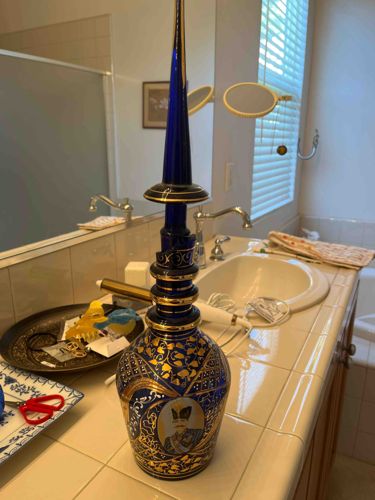
Persian Nasir al-Din Shah Qajar Cobalt Blue Glass Decanter

Antique Glassware & Persian Art

AI Estimated Value

·Not an official valuation·Verify before acting

$400 - $600 USD

As of June 25, 2026

AI Item Analysis

·AI can make mistakes·Verify before acting
This is a tall, ornate decanter or rosewater sprinkler crafted from cobalt blue glass, heavily decorated with 24K gold gilt enamel. The piece features a bulbous body that tapers into a long, tiered neck, topped with a dramatic, sword-like elongated spire stopper. A central medallion on the body depicts a portrait of Nasir al-Din Shah Qajar, who ruled Persia in the 19th century. The surrounding surfaces are densely covered in intricate Persian motifs, including scrolling floral patterns (islimi), geometric latticework, and foliate borders. The gold application shows significant craftsmanship, utilizing both thick raised enamel and fine detailed linework. The glass is a deep, rich cobalt blue that appears translucent when backlit. In terms of condition, there is a prominent break and loss of glass at the upper neck section below the second gold ring, indicating a structural failure. There is also visible wear to the gold gilding on the high-relief rings of the neck and some light surface scratching on the base. This style of vessel, often referred to as 'Qajar glass,' was popularized in the late 19th to mid-20th century as commemorative or decorative ware, likely produced in Iran or by European glassmakers (such as Bohemian workshops) for the Persian market. Standing approximately 18-22 inches tall including the stopper, it represents a high level of decorative artistry despite the damage.

AI Appraisal Report

·AI can make mistakes·Verify before acting
I have examined the images of this cobalt blue glass decanter featuring the portrait of Nasir al-Din Shah Qajar. The piece is a classic example of Qajar-era revivalist glassware, likely produced in the late 19th or early 20th century. The intricate 24K gold gilt enamel work follows traditional 'islimi' patterns, and the portraiture indicates it was intended as a high-status commemorative object. The deep cobalt hue is consistent with Bohemian glass blanks exported to Persia, which were then decorated locally or by specialists in Europe for the Persian court. The primary factor impacting value is the significant structural damage. I observed a severe break and loss of glass at the upper neck section. In the current market for Persian antiquities, collectors prioritize 'cabinet-grade' condition; a fracture of this magnitude in a glass specimen typically reduces the fair market value by 60-70% compared to a pristine example. While the gold enamel remains largely intact, the loss of the vessel's silhouette integrity is a major deterrent for high-end collectors. Provenance documentation is currently absent, which further limits the valuation. To fully authenticate this as a 19th-century royal commission versus a mid-20th century decorative souvenir, an in-person examination is required. Specifically, I would need to check for natural base wear patterns, examine the 'pontil' mark at the bottom, and use UV light to inspect for previous adhesive repairs or enamel consistency. Without physical handled inspection, this assessment remains a preliminary estimate based on visual aesthetics and known market trends for damaged Qajar decorative arts.

Get your items appraised

Instant estimates of your treasures with AI-powered appraisals

Browse More Appraisals