AI estimate as of July 12, 2025 · verify with a professional before acting
AI-Generated · Verify before acting
Everything on this page is generated by AI for informational purposes only. AI can make mistakes — the AI may misidentify items or misattribute them (artist, maker, brand, designer, origin, era). This is not an official valuation and should not be used for insurance, sale, tax, estate, legal, or lending purposes — or any decision requiring a certified appraisal. It is not an authoritative claim about any person, brand, or rights holder — do not share or rely on it as a factual statement about a third party. Always consult qualified professionals before making financial decisions.
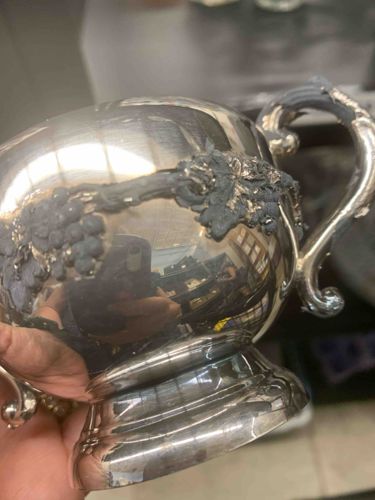
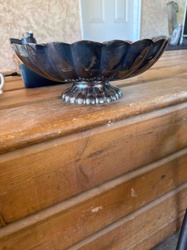
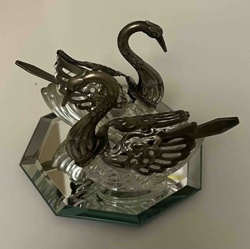
This item appears to be a silver-plated or sterling silver sugar bowl, based on its highly reflective metallic surface and the presence of a handle, often found on serving pieces for sugar. Its physical characteristics include a rounded, bowl-shaped body set upon a stepped, circular foot, providing stability. The overall size appears to be typical for a sugar bowl, likely fitting comfortably in one hand, suggesting a height of approximately 4-6 inches and a similar diameter. The material is a bright, polished silver color, and the construction shows signs of both cast and embossed elements. On one side, there is a prominent decorative motif resembling a cluster of grapes and leaves, indicating a naturalistic or possibly Rococo Revival aesthetic. A notable feature is the ornate, scrolled handle attached to the upper rim, which appears to have a decorative thumb rest or finial at its top. Crucially, there is significant damage visible, particularly around the attachment points of the handle and next to the grape motif. This damage manifests as dark, discolored, and textured residue, which could be solder, adhesive, or tarnish, suggesting a previous repair attempt or severe corrosion. This area exhibits a burnt or melted appearance, significantly impacting the aesthetic integrity and potentially the structural soundness. The rest of the polished surface also shows minor scratches and smudges consistent with handling and usage, but no major dents or deformations are immediately apparent outside the damaged area. The craftsmanship, aside from the damage, suggests a degree of skill in the casting and polishing of the metalwork, although the visible repair attempts detract from its quality. Without maker's marks, it is difficult to determine the exact manufacturing details or precise age, but the style of the handle and grape motif could place it anywhere from the late 19th to early 20th century. The unique aspect is the extent of the repair or damage, which is a major factor for appraisal.
AI Appraisal Report
Upon visual examination of this silver-colored sugar bowl, my assessment is that it is a silver-plated piece, likely from the late 19th or early 20th century, in the Rococo Revival style as indicated by the grape and leaf motif. While the form itself is classic, the most significant factor impacting its value is the severe damage present. There is a large, discolored, and melted area near the handle's attachment point and the embossed decoration. This appears to be a crude and failed solder repair, which has not only disfigured the piece aesthetically but also compromised its structural integrity. This damage is so extensive that it renders the bowl non-functional for its original purpose and severely detracts from its display quality. The market for damaged silver-plate tableware is extremely limited. Collectors and decorators seek items in good to excellent condition. An item this heavily damaged holds little to no value beyond its potential as scrap metal, which for silver-plate is negligible. Comparable silver-plated sugar bowls from this era in good condition might sell for $20-$40, but the cost to professionally restore this piece would far exceed its market value. Therefore, its primary value is as a decorative object for someone who appreciates a distressed or 'wabi-sabi' aesthetic, or for use as a theatrical prop. Authentication of the material as sterling silver versus silver-plate would require in-person testing of hallmarks or acid testing. However, even if it were sterling, the value would be limited to its scrap metal weight due to the extent of the damage.