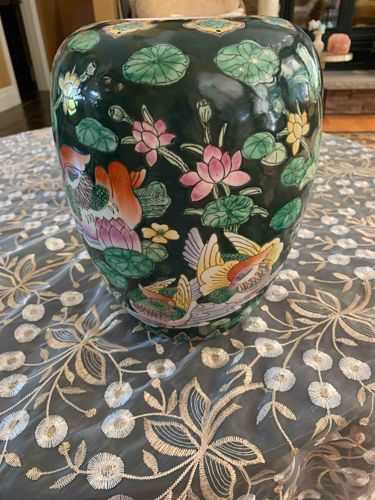
Chinese vintage jar familie rose Color’s with mandarin ducks on black background qianlong era
These notes were written by the person who submitted this item. Appraiser.AI has not verified them, and the AI's identification and estimate may rely on them.
AI Estimated Value
Not an official valuation
$800 - $1,500
AI estimate as of July 18, 2025 · verify with a professional before acting
AI-Generated · Verify before acting
Everything on this page is generated by AI for informational purposes only. AI can make mistakes — the AI may misidentify items or misattribute them (artist, maker, brand, designer, origin, era). This is not an official valuation and should not be used for insurance, sale, tax, estate, legal, or lending purposes — or any decision requiring a certified appraisal. It is not an authoritative claim about any person, brand, or rights holder — do not share or rely on it as a factual statement about a third party. Always consult qualified professionals before making financial decisions.
This analysis also relies on unverified notes provided by the user, which may be incomplete or inaccurate and could affect the result.
This is a Chinese vintage jar, likely a ginger jar or a garden seat, executed in the Famille Rose palette on a distinctive black background. The overall form is a broad, barrel-shaped vessel with a slightly tapered rim, suggesting an opening. The primary decorative motif features lush lotus flowers and leaves, interspersed with what are described as mandarin ducks, although the birds depicted more closely resemble pheasants or other ornamental fowl, characterized by vibrant orange, yellow, pink, and green plumage, contrasting with the dark ground. The black background, often referred to as 'Famille Noire' or 'noir ground,' is a notable feature, giving the vibrant enamel colors outstanding prominence. The enamel colors seen on the birds and flowers are typical of the Famille Rose palette, including soft pinks, blues, greens, yellows, and oranges, all outlined in black or darker tones to define details. The surface appears to be highly glazed, showing a considerable amount of reflectivity, indicating well-fired porcelain. There are subtle variations in the black ground, hinting at potential hand-painting or minor imperfections from the manufacturing process. No obvious chips, cracks, or repairs are immediately visible from the provided images, but a detailed inspection would be necessary to confirm the absence of such damage. The design elements, particularly the rich black ground and the specific pastel enamels, suggest a Qianlong era (1736-1795) attribution, or at least a piece crafted in the style of that period, given the 'vintage' designation in the context. The craftsmanship appears to be of good quality, with fine details in the painting of the feathers and the veins of the leaves. The overall aesthetic is one of floral abundance and symbolic birds, common in Chinese decorative arts. The condition appears good from the images, with some minor surface inconsistencies possibly due to age and handling, often referred to as 'patina'. The lack of visible maker's marks or signatures is common for older Chinese ceramics unless it's an imperial piece or a well-documented workshop. The robust form indicates it was designed for practical use, possibly as a storage jar or as an ornamental piece.
AI Appraisal Report
Upon examining the provided images and description, this Chinese Famille Rose jar on a black ground, often referred to as 'Famille Noire', presents several key characteristics. The piece exhibits a vibrant enamel palette featuring lotus blossoms and birds, described as mandarin ducks but visually closer to pheasants, set against a striking black background. This combination is stylistically reminiscent of wares produced during the Qianlong period (1736-1795). The overall condition appears good from the images, with no major visible chips or cracks. The quality of the painting shows competent detail in the flora and fauna.
The market for Chinese ceramics, especially those with Qianlong attributions, remains strong. However, pieces in the Famille Noire style were heavily reproduced in the late 19th and 20th centuries. The primary factor influencing value is authenticity. A genuine Qianlong period piece in this style would be exceptionally rare and valuable, fetching hundreds of thousands or more. Conversely, a 20th-century Republic period or later reproduction, while decorative, would be valued significantly lower. Market comparables for high-quality reproductions from the early to mid-20th century typically range from $800 to $2,000, depending on size and artistic merit.
It is crucial to note that authentication from images alone is impossible. To confirm a Qianlong period attribution, a physical examination is required to assess the paste, glaze texture, footrim characteristics, and any potential reign marks. Scientific testing, such as Thermoluminescence (TL) testing, would be necessary to definitively date the piece. Without in-person inspection and provenance, this appraisal assumes the item is a high-quality 20th-century decorative piece in the Qianlong style.