Cullet (Slag Glass) Fragment
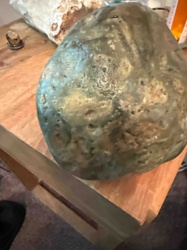
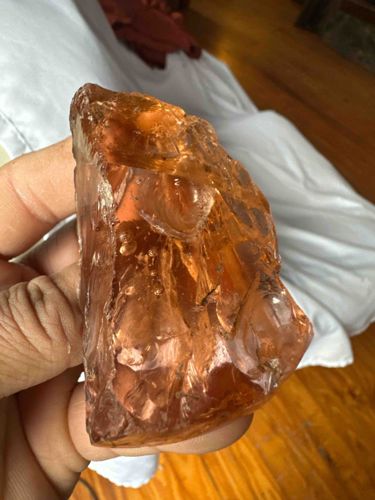
This item is a large chunk of cullet or 'slag glass,' likely a byproduct of industrial glass manufacturing. It exhibits a vibrant apricot or honey-amber hue and is translucent to transparent in quality. Physically, the piece measures approximately three to four inches in length, featuring a rugged, irregular shape with prominent conchoidal fracturing. This shell-like breakage pattern is characteristic of amorphous silica materials. The internal structure contains various spherical gas bubbles (seeds) of varying sizes, which indicate it was cooled from a molten state rather than formed through natural geological processes like quartz or amber. The exterior surfaces show a mix of sharp, fresh glassy edges and matte, slightly weathered areas. There are no maker's marks or signatures visible, as this is raw material rather than a finished piece of decorative art or glassware. It appears to be an mid-20th-century specimen, often salvaged from glass factory dump sites. The lack of a crystal structure and the presence of uniform coloring throughout suggest This is man-made glass, valued primarily by collectors of industrial artifacts or as raw material for landscape decoration and lapidary work.
AI-Generated Appraisal Disclaimer
Estimated Value
$15.00 - $25.00
Basic Information
Category
Industrial Glass Artifacts
Appraised On
January 25, 2026
Estimated Value
$15.00 - $25.00
Item Description
This item is a large chunk of cullet or 'slag glass,' likely a byproduct of industrial glass manufacturing. It exhibits a vibrant apricot or honey-amber hue and is translucent to transparent in quality. Physically, the piece measures approximately three to four inches in length, featuring a rugged, irregular shape with prominent conchoidal fracturing. This shell-like breakage pattern is characteristic of amorphous silica materials. The internal structure contains various spherical gas bubbles (seeds) of varying sizes, which indicate it was cooled from a molten state rather than formed through natural geological processes like quartz or amber. The exterior surfaces show a mix of sharp, fresh glassy edges and matte, slightly weathered areas. There are no maker's marks or signatures visible, as this is raw material rather than a finished piece of decorative art or glassware. It appears to be an mid-20th-century specimen, often salvaged from glass factory dump sites. The lack of a crystal structure and the presence of uniform coloring throughout suggest This is man-made glass, valued primarily by collectors of industrial artifacts or as raw material for landscape decoration and lapidary work.
Related Tags
Get Your Items Appraised
Instant estimates of your treasures with AI-powered instant appraisals