Carved Nephrite Jade Dragon-Fish (Yu-Long) C-Shaped Amulet
Asian Antiques & Decorative Arts

Carved Nephrite Jade Dragon-Fish (Yu-Long) C-Shaped Amulet

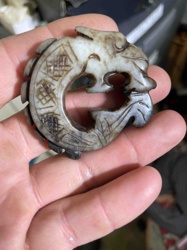
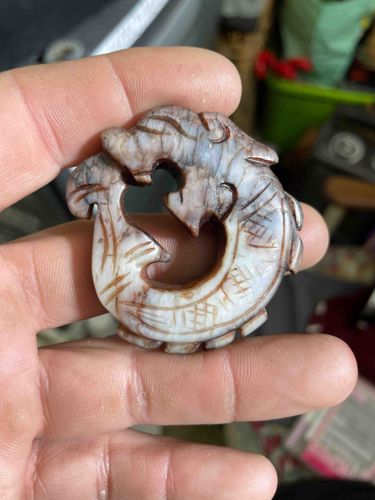
A small, hand-carved stone amulet, likely nephrite jade, approximately two inches in diameter. The piece is rendered in a circular or 'C-shaped' form, characteristic of the Hongshan and Liangzhu cultures. It features a hybrid Mythical creature—often interpreted as a 'Dragon-Fish' or 'Pig Dragon'—with a prominent head, snout, and a body accented with cross-hatched scales and linear engravings. The stone possesses a multi-tonal appearance, dominated by a pale celadon or milky-white base heavily suffused with reddish-brown calcifications, iron oxide staining, and natural veining that suggests significant age. The carving demonstrates traditional lapidary techniques with deep incisions to define the features and a central void created by manual drilling. Surface condition shows substantial weathering, pitted areas, and a soft waxy luster. The incised lines contain darker residue, either from intentional staining or burial patina. The overall style is reminiscent of Neolithic Chinese jades, though many such items found today are early to mid-20th-century reproductions made to mimic ancient archaic styles through chemical aging processes. The craftsmanship is expressive but shows some irregularity in the hatch-marks, reflecting a hand-finished quality rather than modern machine precision.
Estimated Value

$100 - $300

Basic Information

Category

Asian Antiques & Decorative Arts

Appraised On

December 23, 2025

Estimated Value

$100 - $300

Item Description

A small, hand-carved stone amulet, likely nephrite jade, approximately two inches in diameter. The piece is rendered in a circular or 'C-shaped' form, characteristic of the Hongshan and Liangzhu cultures. It features a hybrid Mythical creature—often interpreted as a 'Dragon-Fish' or 'Pig Dragon'—with a prominent head, snout, and a body accented with cross-hatched scales and linear engravings. The stone possesses a multi-tonal appearance, dominated by a pale celadon or milky-white base heavily suffused with reddish-brown calcifications, iron oxide staining, and natural veining that suggests significant age. The carving demonstrates traditional lapidary techniques with deep incisions to define the features and a central void created by manual drilling. Surface condition shows substantial weathering, pitted areas, and a soft waxy luster. The incised lines contain darker residue, either from intentional staining or burial patina. The overall style is reminiscent of Neolithic Chinese jades, though many such items found today are early to mid-20th-century reproductions made to mimic ancient archaic styles through chemical aging processes. The craftsmanship is expressive but shows some irregularity in the hatch-marks, reflecting a hand-finished quality rather than modern machine precision.
Get Your Items Appraised

Instant estimates of your treasures with AI-powered instant appraisals

Browse More Appraisals