AI Appraisal Estimate

AI-generated estimates · not official valuations

From the user

What was submitted

Photo and notes provided by the user — not generated by AI

Submitted item photo
Submitted photo · May 16, 2026

User's notes

No additional notes provided.

AI analysis below

AI appraisal

AI analysis & estimate

AI-Generated · Verify before acting

Everything below is generated by AI for informational purposes only. AI can make mistakes — the AI may misidentify items or misattribute them (artist, maker, brand, designer, origin, era). This is not an official valuation and should not be used for insurance, sale, tax, estate, legal, or lending purposes — or any decision requiring a certified appraisal. It is not an authoritative claim about any person, brand, or rights holder — do not share or rely on it as a factual statement about a third party. Always consult qualified professionals before making financial decisions.

Read the full disclaimer

AI Identification

·Not independently authenticated·Verify before acting

Anchor Hocking Fire-King Jadeite Glassware

Antique/Vintage Kitchenware and Collectible Glassware

AI Estimated Value

·Not an official valuation·Verify before acting

$45.00 - $65.00

As of May 16, 2026

AI Item Analysis

·AI can make mistakes·Verify before acting
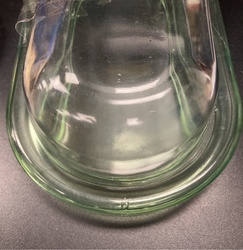
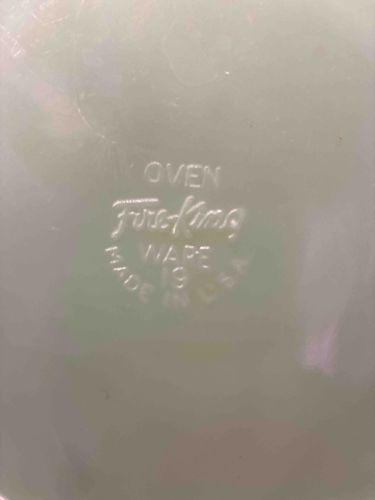
This image features the embossed backstamp of a piece of Fire-King Jadeite glassware, a highly collectible line produced by the Anchor Hocking Glass Corporation. The hallmark consists of the words 'OVEN Fire-King WARE' in a stylized script, with 'MADE IN U.S.A.' curved along the bottom and a mold number '19' in the center. The material is the iconic semi-translucent, milky pale-green borosilicate glass known commercially as 'Jadeite' or 'Jadite.' This specific mark style was typically used during the mid-to-late 1940s and through the 1950s, representing the peak of Mid-Century Modern kitchenware production. The glass displays a smooth, glossy finish with the characteristic 'orange peel' texture common to pressed glass of this era. Regarding condition, the surface shows a healthy luster, though minor manufacturing inclusions such as 'straw marks' (swirl lines) or tiny air bubbles—which are standard for this type of industrial glassware—may be present but are not visible in this close-up. There is an absence of significant chips or 'flea bites' on the raised lettering of the mark, suggesting a well-preserved state. Jadeite was prized for its durability and heat resistance, designed originally as inexpensive, sturdy dinnerware that has since become a staple of Americana aesthetic. The craftsmanship is industrial-grade, noted for its heavy weight and uniform color consistent with high-quality mid-century American glass production.

AI Appraisal Report

·AI can make mistakes·Verify before acting
I have examined the digital image provided of this Fire-King Jadeite piece, focusing specifically on the embossed backstamp. The mark 'OVEN Fire-King WARE MADE IN U.S.A.' with the central mold number '19' is consistent with Anchor Hocking production from the mid-to-late 1940s and early 1950s. The semi-translucent, milky green coloration and 'orange peel' texture are hallmarks of authentic Jadeite of this era. Based on the visual evidence, the piece appears to be in Excellent vintage condition with high surface luster and no visible chips to the raised lettering. The market for Jadeite remains strong, particularly for specimens featuring the 'OVEN Fire-King WARE' script mark, which collectors often prefer over later block-letter marks. While Jadeite was mass-produced, the values of individual pieces vary significantly by form (e.g., Jane Ray vs. Restaurant Ware). Based on the mold number '19', this likely belongs to a standard dinnerware line. Values are bolstered by the current 'farmhouse' and Mid-Century Modern kitchenware trends. Limitations: This appraisal is based solely on a high-resolution photograph of the hallmark. A definitive authentication requires a physical examination to check for 'flea bites' along the rim, hairline heat cracks not visible in photos, and weight verification to rule out modern reproductions. I would also need to see the complete form of the vessel to determine if it is a common saucer or a rarer mixing bowl. For full valuation, physical inspection under UV light is recommended to ensure there are no professional repairs.

Get your items appraised

Instant estimates of your treasures with AI-powered appraisals

Browse More Appraisals