AI Appraisal Estimate

AI-generated estimates · not official valuations

From the user

What was submitted

Photo and notes provided by the user — not generated by AI

Submitted item photo
Submitted photo · June 23, 2026

User's notes

Clementine Hunter

AI analysis below

AI appraisal

AI analysis & estimate

AI-Generated · Verify before acting

Everything below is generated by AI for informational purposes only. AI can make mistakes — the AI may misidentify items or misattribute them (artist, maker, brand, designer, origin, era). This is not an official valuation and should not be used for insurance, sale, tax, estate, legal, or lending purposes — or any decision requiring a certified appraisal. It is not an authoritative claim about any person, brand, or rights holder — do not share or rely on it as a factual statement about a third party. Always consult qualified professionals before making financial decisions.

Note

This analysis also relies on unverified notes provided by the user, which may be incomplete or inaccurate and could affect the result.

Read the full disclaimer

AI Identification

·Not independently authenticated·Verify before acting

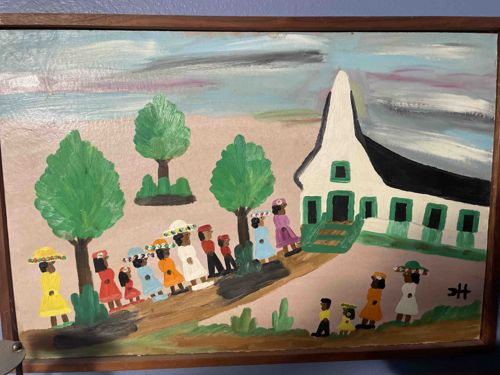
Clementine Hunter Painting of a Church Procession

Fine Art - Folk Art Painting

AI Estimated Value

·Not an official valuation·Verify before acting

$5,000 - $8,000

As of June 23, 2026

AI Item Analysis

·AI can make mistakes·Verify before acting
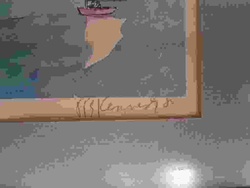
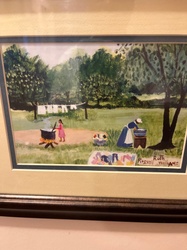
This is an original oil or casein painting on board by the renowned self-taught folk artist Clementine Hunter (1886–1988). The composition features a characteristic scene of a rural congregation processing toward a white chapel with a black roof and green trim. A line of figures, mostly women in vibrant Sunday dresses—yellow, red, blue, orange, and white—with decorative wide-brimmed hats, follows a dirt path toward the entrance. Hunter’s signature 'CH' monogram is clearly visible in the lower right quadrant. The work exhibits her signature flat perspective and simplified, expressive forms. The palette is dominated by earthy browns, vibrant greens for the stylized trees, and various bright hues for the figures, set against a muted pinkish-beige ground and a streaked sky of blue, grey, and white. The painting is housed in a simple dark wood frame which appears to be in sound condition. There are minor visible surface irregularities consistent with the artist's choice of humble materials and thick paint application (impasto). The overall condition appears excellent for a mid-20th-century folk art piece, with no significant flaking or loss visible from the image. This piece possesses all the hallmark qualities of Hunter’s documentation of life at Melrose Plantation.
AI Appraisal Report

·AI can make mistakes·Verify before acting
I have virtually examined this oil/casein on board attributed to Clementine Hunter. The work depicts a church procession, one of Hunter's most iconic and sought-after thematic series documenting Cane River life at Melrose Plantation. Visually, the piece exhibits the hallmark 'CH' monogram, flat perspective, and vibrant 'Sunday best' palette expected of a mid-to-late period work (circa 1950s-70s). The surface shows characteristic impasto and the use of humble materials, which appear stable with no visible 'alligatoring' or significant paint loss. The market for Hunter remains robust; she is a cornerstone of American Folk Art, and church scenes typically command a premium over simpler floral or single-figure compositions. Recent auction results for similar procession scenes of this scale and vibrancy have consistently reached mid-four to low-five-figure sums. The primary factor driving this valuation is the clarity of the narrative and the excellent state of preservation. However, as this examination is based on digital images, this valuation is conditional. While the stylistic markers are consistent with Hunter's hand, her high market volume has led to numerous imitations. For definitive authentication, I would require an in-person inspection to verify the paint chemistry and board age. Furthermore, provenance documentation—ideally tracing the work back to Melrose Plantation or a known early collector—is essential to reach the high-estimate valuation and ensure the work's historical integrity in the secondary market.

Get your items appraised

Instant estimates of your treasures with AI-powered appraisals

Browse More Appraisals