These notes were written by the person who submitted this item. Appraiser.AI has not verified them, and the AI's identification and estimate may rely on them.
AI Estimated Value
Not an official valuation
$2,200 - 2,800
AI estimate as of July 12, 2025 · verify with a professional before acting
AI-Generated · Verify before acting
Everything on this page is generated by AI for informational purposes only. AI can make mistakes — the AI may misidentify items or misattribute them (artist, maker, brand, designer, origin, era). This is not an official valuation and should not be used for insurance, sale, tax, estate, legal, or lending purposes — or any decision requiring a certified appraisal. It is not an authoritative claim about any person, brand, or rights holder — do not share or rely on it as a factual statement about a third party. Always consult qualified professionals before making financial decisions.
This analysis also relies on unverified notes provided by the user, which may be incomplete or inaccurate and could affect the result.
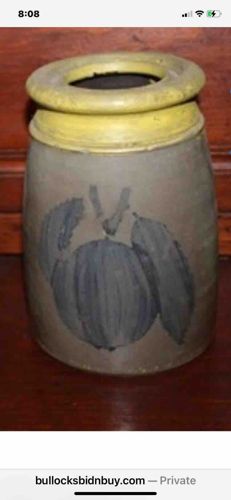
This item is an antique stoneware canning crock, characterized by its cylindrical or slightly tapered form, typical of early food preservation vessels. The material appears to be a robust, coarse-grained stoneware, likely salt-glazed, which imparts a grayish-brown, earthy tone to the body. A distinctive feature is the thick, rolled rim or collar at the top, finished with a contrasting yellow-ochre glaze, suggesting it was designed to accommodate a lid or sealing mechanism. This yellow glaze shows significant wear and discoloration, indicative of age and use. The main body of the crock is adorned with hand-painted cobalt blue or dark gray slip decoration, depicting what appears to be a pumpkin or squash flanked by two large leaves and stems. The artistic style is folk art, with broad, expressive brushstrokes, not highly detailed but clearly recognizable. The overall condition shows considerable patina, with surface abrasions, minor chips visible on the rim, and general wear consistent with its age and utilitarian purpose. There are no obvious signs of major cracks or repairs, but the matte finish of the body suggests decades of handling and possibly burial or exposure to varying conditions. The unevenness of the glaze and the hand-painted decor point to a pre-industrial or early industrial manufacturing period, likely late 19th or early 20th century, before mass production became highly standardized. The quality of craftsmanship, while rustic, is solid and functional, reflecting its vernacular origins.
AI Appraisal Report
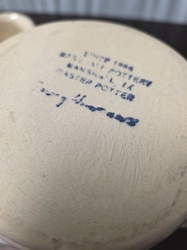
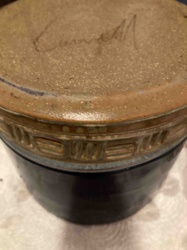
Upon examining the provided image and information for this Antique Folk Art Stoneware Canning Crock, I assess its authenticity as highly probable, consistent with late 19th to early 20th-century American folk art stoneware. The hand-painted cobalt blue decoration, robust stoneware body, salt-glazing (likely), and the rustic craftsmanship align well with period examples. The significant wear, discoloration on the yellow-ochre rim, and surface abrasions contribute to its authentic patina, suggesting decades of use, rather than recent creation. Minor chips on the rim are typical for utilitarian pieces of this age. Physically, I'd want to examine the interior for any repairs, check the base for maker's marks or firing imperfections, and assess any hairline cracks not visible in the image. Understanding the exact clay body, glaze composition, and techniques used would require in-person examination or scientific testing, but visually, it presents as a genuine artifact. Market conditions for American folk art stoneware, particularly pieces with desirable decoration and good scale, remain strong. The reported auction result of $2700 for a 'rare canning crock' provides a direct comparable, indicating robust demand. This crock's 'pumpkin/squash' decoration is highly appealing and contributes significantly to its rarity and desirability. While condition shows expected age-related wear, the absence of major cracks or repairs is a major plus. The folk art style, coupled with its functional origins, enhances its collectible appeal. Without a direct in-person examination, I can't definitively rule out every possibility of modern alteration, but based on the visual evidence, it passes initial authenticity review. Full authentication would benefit from hands-on inspection to assess the glaze and body more thoroughly, and any available provenance documentation.