AI estimate as of August 22, 2025 · verify with a professional before acting
AI-Generated · Verify before acting
Everything on this page is generated by AI for informational purposes only. AI can make mistakes — the AI may misidentify items or misattribute them (artist, maker, brand, designer, origin, era). This is not an official valuation and should not be used for insurance, sale, tax, estate, legal, or lending purposes — or any decision requiring a certified appraisal. It is not an authoritative claim about any person, brand, or rights holder — do not share or rely on it as a factual statement about a third party. Always consult qualified professionals before making financial decisions.
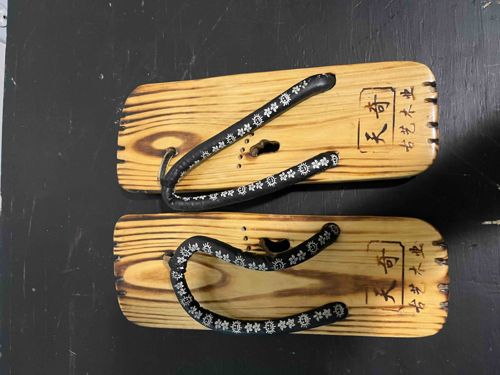
This item is a pair of traditional Japanese geta, specifically a more casual style likely for indoor or light outdoor use. The geta are constructed primarily from a light-colored, possibly cedar or pine, wood with a clear grain visible, suggesting a natural finish or light lacquer to enhance the wood's appearance. The soles are flat, single-piece wooden platforms, showcasing visible saw marks or tooling on the sides and ends, particularly on the front and back where the wood has been cut. Notably, the planks lack the traditional 'ha' (teeth) on the underside, which are characteristic of outdoor geta designed to add height and keep kimono hems from dragging. This flat-soled design, combined with the lack of significant elevation, suggests a comfort-oriented or indoor application. Each geta features a black hanao (thong or strap) with a white floral or geometric pattern printed along its length, adding a decorative element. The hanao are inserted into three holes on the wooden platform – one at the front and two at the sides, near the arch area. The hanao appear to be made of a fabric-covered material, possibly cotton or synthetic, with some light wear visible where they meet the wood. On the top surface of each wooden sole, there are clear, dark ink stampings of Japanese characters, likely indicating a brand name, maker, or possibly a location; these markings are bold and distinct. The overall condition appears good with minor signs of use, such as light scuffing on the wood and subtle wear on the straps, consistent with a vintage or used item. The craftsmanship indicates a functional, mass-produced item, though still adhering to traditional forms. The style period is hard to pinpoint precisely without more context but appears to be 20th-century.
AI Appraisal Report
Upon visual examination of the provided image, I assess this pair of flat-soled Japanese geta to be in good, used condition. The natural wood exhibits light scuffing consistent with wear, and the fabric hanao show minor signs of use where they meet the wood. The clear ink stampings on the soles suggest authenticity as traditional Japanese footwear markings. However, without physical inspection, I cannot confirm if these are authentic vintage pieces or more recent reproductions; the craftsmanship indicates a functional, possibly mass-produced item. Comparables in the market for similar flat-soled geta, particularly those without significant artistic embellishment or rare materials, typically fall into the lower-to-mid price range. Demand for general traditional Japanese geta is stable but not particularly high unless they are exceptionally rare, historically significant, or created by renowned artisans. Factors impacting value here are primarily their utilitarian design and apparent lack of unique features. The flat-soled design, indicative of indoor or casual use, often fetches less than outdoor 'ha' geta. Limitations in authenticity verification from images alone are significant; I cannot definitively confirm the wood type, age, or manufacturing techniques. For full authentication, in-person examination would be required to assess wood grain and aging, textile analysis of the hanao, and microscopic examination of the ink stampings. Provenance documentation, such as original purchase receipts or historical photos, would also be highly beneficial.