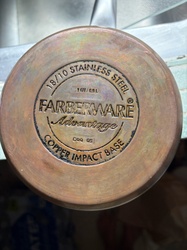
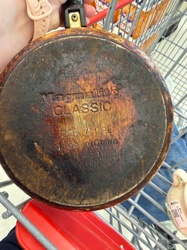
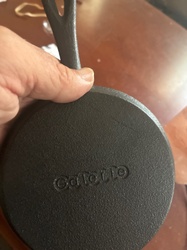
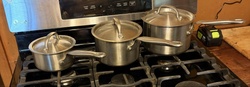
These notes were written by the person who submitted this item. Appraiser.AI has not verified them, and the AI's identification and estimate may rely on them.
AI Estimated Value
Not an official valuation
$50 - $120
AI estimate as of November 29, 2025 · verify with a professional before acting
AI-Generated · Verify before acting
Everything on this page is generated by AI for informational purposes only. AI can make mistakes — the AI may misidentify items or misattribute them (artist, maker, brand, designer, origin, era). This is not an official valuation and should not be used for insurance, sale, tax, estate, legal, or lending purposes — or any decision requiring a certified appraisal. It is not an authoritative claim about any person, brand, or rights holder — do not share or rely on it as a factual statement about a third party. Always consult qualified professionals before making financial decisions.
This analysis also relies on unverified notes provided by the user, which may be incomplete or inaccurate and could affect the result.
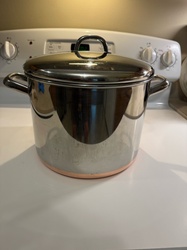
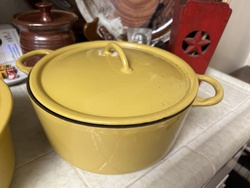
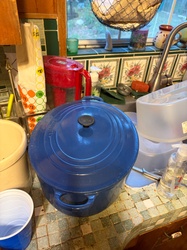
The image displays two distinct cast iron skillets resting on a stovetop. The larger of the two is identified as a Griswold cast iron pan, possessing the characteristic dark, matte finish of seasoned cast iron. Its interior surface shows uneven silvery-gray patches, indicating either wear to the seasoning, residue from cooking, or possibly areas where food has stuck. The pan appears to be a standard depth skillet with a gently sloping side profile. The handle is integrated seamlessly into the body, a common feature of vintage cast iron. Due to the angle, specific markings like the Griswold logo or size number are not discernible, but such markings are typically located on the underside of the pan. The pan exhibits a generally robust and heavy construction, typical of quality cast iron cookware designed for even heat distribution and retention. The smaller item is a miniature cast iron skillet, perhaps designed for a single egg or a small individual serving. It also possesses the characteristic dark finish, with a slightly more uniform surface visible on its interior. The handle is proportionally long for its size and features a hanging hole at the end, suggesting it could be stored by hanging. Both pans show evidence of regular use, with the larger Griswold pan presenting visible variations in its seasoned surface which might require re-seasoning to uniformly restore its non-stick properties and protective layer. The exact age is difficult to determine without visible maker's marks, but Griswold cast iron pans vary widely in age, with many sought-after pieces dating from the late 19th to mid-20th centuries. The craftsmanship of both items reflects the durability and utilitarian design inherent to cast iron cookware.
AI Appraisal Report
I have examined the provided image of two cast iron skillets, one identified as a Griswold and a miniature skillet. The larger Griswold pan displays a typical dark, matte seasoned finish, though the interior shows uneven silvery-gray patches. This suggests wear to the seasoning, cooking residue, or possibly areas where food has stuck, indicating a need for re-seasoning to restore its non-stick properties and protective layer. The construction appears robust, consistent with vintage cast iron. The smaller, miniature skillet also has a dark finish and a proportionally long handle with a hanging hole. Both exhibit characteristics of regular use.
Authenticity of the larger pan as a Griswold is highly probable given the general profile and common knowledge of the brand, but without visible maker's marks, size numbers, or logos (typically on the underside), I cannot definitively confirm its authenticity or specific model/age solely from this image. A physical inspection would be necessary to verify these critical details. The condition of the seasoning on the Griswold significantly impacts its immediate usability and thus its value; a pan requiring immediate re-seasoning will fetch less than one perfectly seasoned.
Market conditions for vintage Griswold cast iron are generally strong, with prices fluctuating based on condition, rarity of the specific model (e.g., slant logo vs. block logo, spider logo), and absence of defects like cracks or pitting. The miniature skillet adds some value, likely in the $10-$20 range on its own. Rarity depends entirely on the specific Griswold model, which cannot be determined here. Given the visible wear on the seasoning and the inability to confirm markings, I estimate the combined value of these two items to be between $50 and $120. Factors significantly impacting higher value would include visible rare Griswold markings, excellent underlying metal condition, and less obvious wear on the seasoning. Full authentication and a more precise valuation would require an in-person examination to inspect the underside markings, check for warping, cracks, or severe pitting, and assess the overall tactile quality of the metal.