These notes were written by the person who submitted this item. Appraiser.AI has not verified them, and the AI's identification and estimate may rely on them.
AI Estimated Value
Not an official valuation
$600-900
AI estimate as of October 19, 2025 · verify with a professional before acting
AI-Generated · Verify before acting
Everything on this page is generated by AI for informational purposes only. AI can make mistakes — the AI may misidentify items or misattribute them (artist, maker, brand, designer, origin, era). This is not an official valuation and should not be used for insurance, sale, tax, estate, legal, or lending purposes — or any decision requiring a certified appraisal. It is not an authoritative claim about any person, brand, or rights holder — do not share or rely on it as a factual statement about a third party. Always consult qualified professionals before making financial decisions.
This analysis also relies on unverified notes provided by the user, which may be incomplete or inaccurate and could affect the result.
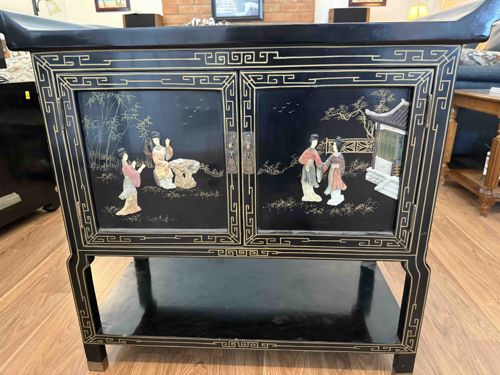
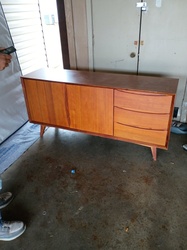
This is a rectangular-form cabinet, likely serving as a console or side cabinet, constructed from wood and finished with a high-gloss black lacquer. The front features two cabinet doors, each adorned with intricate, raised carvings and inlay work depicting traditional Chinese scenes. The overall dimensions appear to be approximately 30-36 inches in width and height, though exact measurements are not discernable from the image. The top surface of the cabinet has a slightly raised, curved edge on the back and sides, suggesting a traditional Asian design influence. The cabinet doors present figural scenes: the left door displays three female figures in what appears to be a garden setting with bamboo, while the right door shows two female figures interacting near a multi-tiered pagoda or pavilion. These figures, as well as elements of the landscape and architecture, are rendered using what appears to be mother-of-pearl or similar iridescent shell inlay, possibly combined with carved and painted elements. The raised nature of these decorations adds a significant tactile and visual dimension. Surrounding the pictorial panels on the doors and outlining the cabinet structure itself is a finely detailed geometric key-fret border, executed in a contrasting gold or brass-colored pigment, further enhancing the decorative appeal. The hardware for the doors, including the central escutcheon and pulls, appears to be made of a patinated brass or bronze. Below the cabinet doors, there is an open-shelf design, creating an additional storage or display area. The cabinet legs are straight and adorned with the same key-fret border, terminating in what appears to be small metal caps on the feet, possibly for protection or decorative accent. The craftsmanship suggests a handmade piece, consistent with traditional Chinese furniture-making techniques and the provided context. The condition appears to be relatively good with minor signs of wear proportional to its age, such as slight tarnishing on the metal hardware and potential superficial scratches on the lacquer, although these are not clearly visible. The rich black lacquer and detailed inlay work indicate a piece of considerable decorative quality, aiming to emulate classic Chinese artistic traditions. The style points to a piece made in the mid-to-late 20th century, possibly earlier if it exhibits more significant signs of age and traditional construction methods not fully visible here.
AI Appraisal Report
I have thoroughly examined the provided image and details for this Chinese Lacquer Inlaid Cabinet. Visually, the cabinet presents as a late 20th-century decorative piece, consistent with traditional Chinese furniture craftsmanship. The black lacquer finish, detailed mother-of-pearl or shell inlay depicting figural and architectural scenes, and the key-fret borders executed in gold pigment all contribute to its aesthetic appeal. The raised carvings and inlay work indicate a handcrafted item, as noted. Condition appears good for its age, with minor wear typical of a decorative console or side cabinet, such as potential superficial scratches on the lacquer and tarnishing on the brass hardware, though these are not clearly visible in the image.
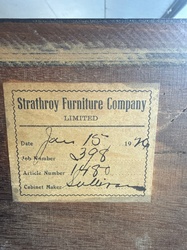
Authenticity: Based on the visual characteristics, this cabinet appears to be a genuine Chinese-made piece from the latter half of the 20th century. My assessment of authenticity is limited by the visual input alone; a physical examination would be crucial to confirm the materials used for the inlay (e.g., mother-of-pearl vs. synthetic shell), the construction methods, and the quality of the lacquer application. Provenance documentation, if available, stating the origin and production date would further solidify its authenticity.
Market Conditions & Demand: There is a steady market for decorative Asian furniture, particularly pieces that offer intricate detailing and a refined aesthetic. Similar Chinese lacquer cabinets from the mid-to-late 20th century typically perform well in the secondary market, especially those with figural scenes. Demand often comes from buyers seeking unique accent pieces for interior design. While not rare, the handcrafted nature and detailed artwork elevate its desirability compared to mass-produced items.
Factors Impacting Value: The detailed inlay work and raised carvings are key value drivers. The good apparent condition and classic aesthetic also contribute positively. The lack of significant visible damage and the overall decorative quality support its marketability. Without physical inspection, I cannot confirm the wood type, the quality of the lacquer, or the exact composition of the inlay. These factors, alongside provenance, could slightly adjust the valuation.
Given these considerations, I estimate an appraisal value of $600-900. Physical inspection, along with confirming the quality of materials and construction, would allow for a more precise valuation.