These notes were written by the person who submitted this item. Appraiser.AI has not verified them, and the AI's identification and estimate may rely on them.
AI Estimated Value
Not an official valuation
$250-400
AI estimate as of December 10, 2025 · verify with a professional before acting
AI-Generated · Verify before acting
Everything on this page is generated by AI for informational purposes only. AI can make mistakes — the AI may misidentify items or misattribute them (artist, maker, brand, designer, origin, era). This is not an official valuation and should not be used for insurance, sale, tax, estate, legal, or lending purposes — or any decision requiring a certified appraisal. It is not an authoritative claim about any person, brand, or rights holder — do not share or rely on it as a factual statement about a third party. Always consult qualified professionals before making financial decisions.
This analysis also relies on unverified notes provided by the user, which may be incomplete or inaccurate and could affect the result.
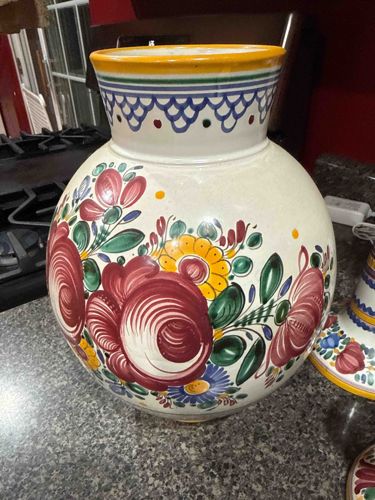
This is a large, globular pottery vase, likely ceramic or earthenware, consistent with traditional Modra majolica or similar folk art pottery. The vase features a prominent bulbous body narrowing into a cylindrical neck, topped with a flared rim. The primary color of the base glaze is an off-white or cream, providing a canvas for the vibrant, hand-painted floral and geometric decorations. The neck of the vase is adorned with a band of blue scallop-like patterns, punctuated by red dots, and framed by a solid yellow band at the very top rim and a thin blue line bordering the main body. The main body of the vase is richly decorated with large, expressive floral motifs. Dominant elements include large, stylized flowers with swirling, deep red petals, accented with white highlights. These are interspersed with yellow daisy-like flowers, blue flowers, and various green leaves and foliage, creating a full and dynamic composition. Small yellow and red dots are scattered throughout the design, adding texture and visual interest. The painting style appears to be freehand, characterized by bold brushstrokes and a somewhat rustic, authentic aesthetic. The colors used are bright and contrasting, typical of folk art ceramics. While the image does not show the base, it is likely unglazed or bearing a maker's mark. Based on the style, particularly the blue and white patterns on the neck and the bold floral designs, it strongly resembles traditional Slovak Modra pottery, which often features majolica-style glazing and painting. The condition appears good, with no obvious chips, cracks, or significant wear visible from the provided image. The glaze appears intact and glossy, suggesting it has been well-preserved. Minor imperfections inherent to hand-made pottery, such as slight variations in color or glaze, would be expected and contribute to its charm rather than detracting from its value. This piece exemplifies traditional European folk art pottery, likely dating from the mid-20th century or possibly earlier, depending on specific stylistic nuances and potential maker's marks.
AI Appraisal Report
Upon examining the provided image of this large, globular pottery vase, I can confidently assess it as a Modra Majolica Style Hand-Painted Pottery Vase. The vibrant, hand-painted floral and geometric decorations, particularly the blue scallop patterns on the neck and bold red, yellow, and blue floral motifs, are highly characteristic of traditional Slovak Modra pottery. The freehand style, bold brushstrokes, and contrasting colors all point to an authentic folk art aesthetic. The condition appears to be very good; the glaze is intact and glossy, with no visible chips, cracks, or significant wear, suggesting it has been well-preserved. Minor inconsistencies inherent to handmade pottery are present and contribute to its charm rather than detracting from its value.
From a market perspective, Modra majolica pieces are sought after by collectors of Eastern European folk art and decorative ceramics. While not exceedingly rare, well-maintained, larger examples with intricate hand-painting like this one command respectable values. Comparable sales of similar Modra vases typically fall within the $200-500 range, depending on size, artistic quality, and specific provenance. The demand for authentic, traditional folk art remains steady. Factors positively impacting its value include its good condition and the overall artistic quality of the hand-painting.
Limitations in authenticity verification from images alone exist. While the visual cues strongly suggest authenticity, a definitive assessment would require physical inspection. In-person examination would allow for closer inspection of the ceramic body, glaze layers, and precise painting techniques. Crucially, examining the base for a maker's mark (e.g., 'MODRA' or a specific potter's mark) would provide conclusive evidence of origin and date. Provenance documentation, if available, would further strengthen authentication. Without these, the appraisal is based solely on visual characteristics consistent with known Modra majolica.