AI Appraisal Estimate

AI-generated estimates · not official valuations

From the user

What was submitted

Photo and notes provided by the user — not generated by AI

Submitted item photo
Submitted photo · June 6, 2026

User's notes

No additional notes provided.

AI analysis below

AI appraisal

AI analysis & estimate

AI-Generated · Verify before acting

Everything below is generated by AI for informational purposes only. AI can make mistakes — the AI may misidentify items or misattribute them (artist, maker, brand, designer, origin, era). This is not an official valuation and should not be used for insurance, sale, tax, estate, legal, or lending purposes — or any decision requiring a certified appraisal. It is not an authoritative claim about any person, brand, or rights holder — do not share or rely on it as a factual statement about a third party. Always consult qualified professionals before making financial decisions.

Read the full disclaimer

AI Identification

·Not independently authenticated·Verify before acting

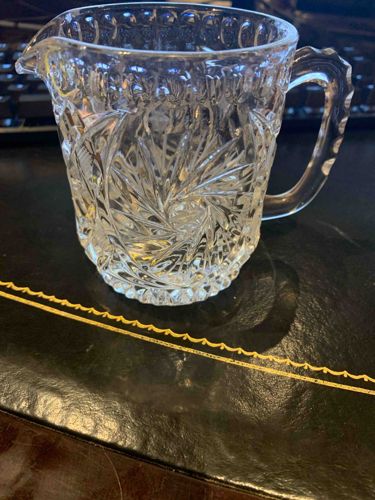
Pressed Glass Creamer Pitcher with Starburst Pattern

Dinnerware / Serveware

AI Estimated Value

·Not an official valuation·Verify before acting

$15-30

As of June 6, 2026

AI Item Analysis

·AI can make mistakes·Verify before acting
This item is a clear glass creamer pitcher, likely made from pressed glass. Its primary physical characteristic is its clear, colorless nature, allowing light to pass through and refract beautifully, indicative of a good quality glass. The body of the creamer is adorned with an intricate, deeply cut pattern that suggests a 'starburst' or 'pinwheel' motif, common in early to mid-20th century pressed glass. This pattern is geometrically complex, featuring radiating lines and diamond-shaped facets that create a visually dynamic surface. The base of the creamer appears to have a more defined radial pattern, perhaps a larger star. The rim is clearly scalloped or fluted, adding to its decorative appeal, and there is a distinct pouring spout at the front. The handle is an integral part of the design, featuring a ribbed or fluted texture that complements the body's patterns and ensures a secure grip. It appears to be a single applied piece, characteristic of many pressed glass creamers. There are no immediately visible chips, cracks, or significant damage, suggesting it is in good pre-owned condition with perhaps only minor wear consistent with age and use. The manufacturing method, pressed glass, means these patterns were molded, often with a high level of detail for mass production. It likely dates from the Edwardian to Art Deco periods, roughly 1900s-1940s, popular for its detailed and affordable glassware. No specific maker's marks or signatures are discernible from the image, which is common for pressed glass. The craftsmanship is evident in the sharpness and consistency of the molded patterns, signifying a well-made utilitarian and decorative piece.
AI Appraisal Report

·AI can make mistakes·Verify before acting
Upon visual examination of the provided images, this item is identified as a pressed glass creamer pitcher from the Early American Pattern Glass (EAPG) era, likely dating between 1900 and 1940. The piece features a prominent 'starburst' or 'pinwheel' motif, a popular design during that period. The glass appears clear and well-molded, with sharp details in the geometric pattern, scalloped rim, and ribbed handle, suggesting good manufacturing quality. Based on the images, the creamer is in good to excellent pre-owned condition, with no visible chips, cracks, or significant clouding. Its value is primarily as a decorative collectible or a functional piece of serveware. The market for EAPG has softened, but well-preserved examples with striking patterns like this one retain modest interest. Comparables for similar, non-branded pressed glass creamers in good condition typically sell in the $15 to $40 range at online auctions and antique shops. The primary factor influencing value is the condition and the appeal of the specific pattern. Rarity is difficult to determine without identifying the exact pattern name and manufacturer, as many companies produced similar designs. The lack of a maker's mark is common for this type of glassware and does not negatively impact value in this price tier. It is important to note that this appraisal is based solely on images. An in-person examination would be required to confirm the absence of hairline cracks, flea bites, or wear not visible in photographs. Furthermore, identifying the specific pattern name, for which reference books are invaluable, could slightly adjust the value if it proves to be a rarer or more sought-after design.

Get your items appraised

Instant estimates of your treasures with AI-powered appraisals

Browse More Appraisals