Carved Celadon Jade Dragon Archer's Ring (Shezhi)
Chinese Antiques / Asian Art & Jewelry

Carved Celadon Jade Dragon Archer's Ring (Shezhi)

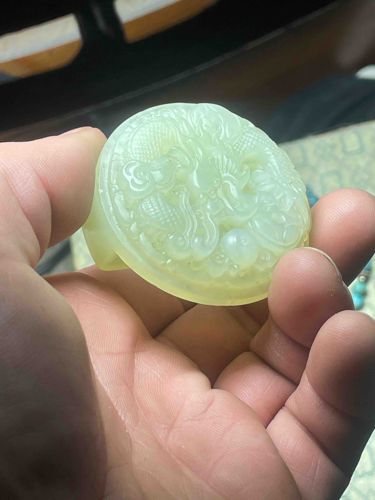
This is a significant Chinese archer’s ring, traditionally known as a 'shezhi', hand-carved from a single piece of celadon jade. The stone displays a desirable pale, translucent greenish-yellow hue often referred to as 'mutton fat' or light celadon, exhibiting a waxy, lustrous surface finish. The face of the ring features an intricate low-relief carving of a stylized dragon amidst celestial motifs and cross-hatched geometric patterns, symbolizing power and high social status. Measuring approximately 3-4 centimeters in diameter, the ring is constructed with a thick, D-shaped profile typical of Qing Dynasty styles (1644–1912). The carving demonstrates precise craftsmanship, particularly in the fluid lines of the dragon’s body and the uniform depth of the background grid. Surface inspection reveals a natural patina and very minor edge wear consistent with traditional use, though the piece lacks major chips or fractures. No visible maker's marks are present, which is standard for such lapidary works. The opacity variations and internal cloud-like inclusions suggest it is a natural nephrite jade rather than a synthetic or soapstone imitation. This piece represents a blend of military function and aristocratic jewelry-making favored during the 18th and 19th centuries.
Estimated Value

$4,000 - $6,500

Basic Information

Category

Chinese Antiques / Asian Art & Jewelry

Appraised On

December 21, 2025

Estimated Value

$4,000 - $6,500

Item Description

This is a significant Chinese archer’s ring, traditionally known as a 'shezhi', hand-carved from a single piece of celadon jade. The stone displays a desirable pale, translucent greenish-yellow hue often referred to as 'mutton fat' or light celadon, exhibiting a waxy, lustrous surface finish. The face of the ring features an intricate low-relief carving of a stylized dragon amidst celestial motifs and cross-hatched geometric patterns, symbolizing power and high social status. Measuring approximately 3-4 centimeters in diameter, the ring is constructed with a thick, D-shaped profile typical of Qing Dynasty styles (1644–1912). The carving demonstrates precise craftsmanship, particularly in the fluid lines of the dragon’s body and the uniform depth of the background grid. Surface inspection reveals a natural patina and very minor edge wear consistent with traditional use, though the piece lacks major chips or fractures. No visible maker's marks are present, which is standard for such lapidary works. The opacity variations and internal cloud-like inclusions suggest it is a natural nephrite jade rather than a synthetic or soapstone imitation. This piece represents a blend of military function and aristocratic jewelry-making favored during the 18th and 19th centuries.
Get Your Items Appraised

Instant estimates of your treasures with AI-powered instant appraisals

Browse More Appraisals