AI estimate as of September 19, 2025 · verify with a professional before acting
AI-Generated · Verify before acting
Everything on this page is generated by AI for informational purposes only. AI can make mistakes — the AI may misidentify items or misattribute them (artist, maker, brand, designer, origin, era). This is not an official valuation and should not be used for insurance, sale, tax, estate, legal, or lending purposes — or any decision requiring a certified appraisal. It is not an authoritative claim about any person, brand, or rights holder — do not share or rely on it as a factual statement about a third party. Always consult qualified professionals before making financial decisions.
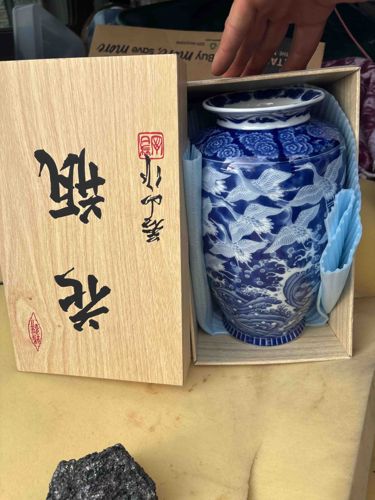
This item is a Japanese blue and white porcelain vase, presented in what appears to be its original kiriwood (paulownia wood) presentation box. The vase exhibits a traditional baluster or ginger jar-like shape with a slightly flared rim, indicating it is likely designed for floral arrangements or as a decorative art piece. Its glaze is a vibrant underglaze blue on a white porcelain body, a classic aesthetic often associated with Arita-ware or Imari-ware, though a specific maker's mark is not visible in the provided image. The decoration features an intricate motif of cranes in flight against a backdrop of stylized clouds and crashing waves, rendered with fine detail. The cranes are depicted in various dynamic poses, suggesting movement and vitality. The base of the vase features a band of vertical stripes, while the neck is adorned with a floral or cloud pattern. The overall condition appears excellent, with no visible chips, cracks, or repairs, maintaining its original luster. The porcelain surface is smooth and glossy, indicative of high-quality firing. The kiriwood box is light-colored and features bold black Japanese calligraphy on its lid, accompanied by red seals, which typically identify the artist, kiln, or workshop, or describe the contents. The interior of the box includes a light blue protective fabric or paper lining, cradling the vase, which further suggests careful storage and presentation, indicating this piece was valued. The craftsmanship, from the painting of the vase to the construction of the protective box, points to a high level of artisanal skill. This style of blue and white porcelain with crane motifs is a recurring theme in Japanese art, often symbolizing longevity and good fortune.
AI Appraisal Report
Based on my visual examination of the images provided, I am appraising this Japanese blue and white porcelain vase with its accompanying kiriwood box. The vase appears to be a high-quality example of Arita-ware, likely from the Showa period (20th century). The underglaze cobalt blue is vibrant, and the hand-painted decoration of cranes and waves is executed with skill and artistic merit. The item appears to be in excellent condition, with no visible signs of chips, cracks, or restoration, retaining its original high-gloss glaze. The inclusion of the original signed kiriwood box significantly enhances its value, adding to its provenance and desirability.
Current market conditions for well-preserved 20th-century Japanese porcelain are stable, with strong interest from collectors of decorative arts. Comparable Arita-ware vases of this size, quality, and condition, particularly those with presentation boxes, have recently sold in the $600 to $900 range at auction and in respected galleries. The classic crane motif, symbolizing longevity, adds to its broad appeal.
The primary limitation of this appraisal is that it is based solely on images. A definitive attribution and authentication would require in-person examination. I would need to physically handle the piece to feel the paste, examine the glaze for age-appropriate wear, and inspect the footrim for characteristics of the period. Furthermore, a professional translation of the calligraphy and seals on the box is crucial to identify the artist or kiln, which could dramatically impact the value if it proves to be a renowned maker. Without this hands-on inspection and translation, the possibility of it being a later reproduction or a piece by a lesser-known workshop cannot be entirely dismissed.