AI Appraisal Estimate

AI-generated estimates · not official valuations

From the user

What was submitted

Photo and notes provided by the user — not generated by AI

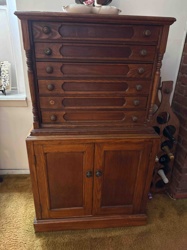
Submitted item photo
Submitted photo · June 17, 2026

User's notes

No additional notes provided.

AI analysis below

AI appraisal

AI analysis & estimate

AI-Generated · Verify before acting

Everything below is generated by AI for informational purposes only. AI can make mistakes — the AI may misidentify items or misattribute them (artist, maker, brand, designer, origin, era). This is not an official valuation and should not be used for insurance, sale, tax, estate, legal, or lending purposes — or any decision requiring a certified appraisal. It is not an authoritative claim about any person, brand, or rights holder — do not share or rely on it as a factual statement about a third party. Always consult qualified professionals before making financial decisions.

Read the full disclaimer

AI Identification

·Not independently authenticated·Verify before acting

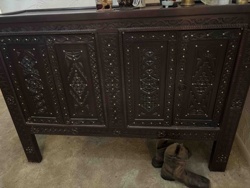
Jacobean Revival Carved Oak Court Cupboard

Antique Furniture / Storage Cabinetry

AI Estimated Value

·Not an official valuation·Verify before acting

$450 - $700

As of June 17, 2026

AI Item Analysis

·AI can make mistakes·Verify before acting
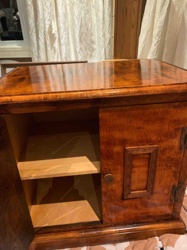
This is a Jacobean Revival style court cupboard, likely dating from the early to mid-20th century. The piece is constructed primarily of oak with a dark English finish. The upper section features a recessed cabinet with four distinct panels, each showcasing intricate relief carvings of foliate or floral motifs, characteristic of the 17th-century aesthetic. A central pull handle is visible on the upper door. The lower section consists of a deep drawer supported by heavy, bulbous 'cup-and-cover' turned legs, typical of the Jacobean period. These legs are connected by a sturdy H-stretcher for structural stability. A decorative scalloped apron sits below the drawer. Regarding condition, the piece shows significant surface patina and some darkening, especially toward the top, which may be intentional or due to age and dust accumulation. There appear to be minor scuffs and wear consistent with age, particularly along the base and edges. The craftsmanship indicates a mass-market revival piece designed to emulate the heavy, ornate furniture of the early 17th century. No specific maker's marks are visible in the provided image, but the overall geometry and proportions suggest a 1920s-1940s production era.
AI Appraisal Report

·AI can make mistakes·Verify before acting
Upon visual examination of this Jacobean Revival court cupboard, I have identified it as a mass-market reproduction dating from the approximately 1920s-1940s. The piece successfully captures the heavy, 'cup-and-cover' bulbous turnings and relief floral carvings characteristic of 17th-century craftsmanship, though executed with modern industrial woodworking techniques. The dark English finish shows significant surface patina and dust accumulation, particularly on the upper recessed cabinet; while some wear is evident on the base and H-stretcher, the structural integrity appears sound based on the heavy-set joinery. The market for mid-20th-century Jacobean Revival furniture is currently stable but modest. While these pieces are valued for their durability and decorative impact, they do not command the high prices of original 17th-century period pieces. Rarity is low, as these were produced in significant quantities by English and American manufacturers for the burgeoning middle-class 'olde world' aesthetic of the interwar period. Similar cupboards at auction typically realize prices between $400 and $800 depending on the specific region and the buyer's need for interior storage solutions. Limitations: This appraisal is based solely on high-resolution images. A physical inspection is required to confirm the secondary woods used for drawer liners, which would help identify the specific region of manufacture. In-person examination of joinery—specifically looking for machine-cut vs. hand-cut dovetails—would definitively establish the production date. Finally, checking for maker's marks or stencils inside the drawer or on the back panel would be necessary for a precise attribution.

Get your items appraised

Instant estimates of your treasures with AI-powered appraisals

Browse More Appraisals