AI Appraisal Estimate

AI-generated estimates · not official valuations

From the user

What was submitted

Photo and notes provided by the user — not generated by AI

Submitted item photo
Submitted photo · June 1, 2026

User's notes

No additional notes provided.

AI analysis below

AI appraisal

AI analysis & estimate

AI-Generated · Verify before acting

Everything below is generated by AI for informational purposes only. AI can make mistakes — the AI may misidentify items or misattribute them (artist, maker, brand, designer, origin, era). This is not an official valuation and should not be used for insurance, sale, tax, estate, legal, or lending purposes — or any decision requiring a certified appraisal. It is not an authoritative claim about any person, brand, or rights holder — do not share or rely on it as a factual statement about a third party. Always consult qualified professionals before making financial decisions.

Read the full disclaimer

AI Identification

·Not independently authenticated·Verify before acting

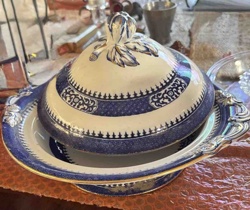
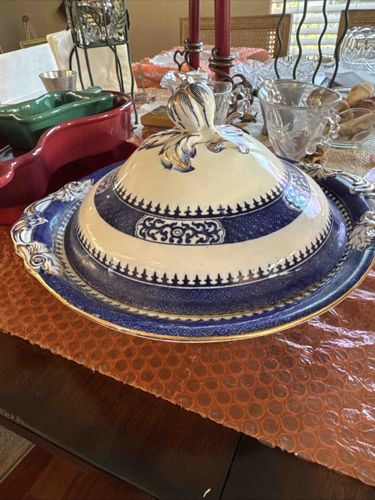
Victorian Era Flow Blue Ironstone Covered Muffin or Entree Dish

Antique Ceramics and Pottery

AI Estimated Value

·Not an official valuation·Verify before acting

$450.00 - $650.00

As of June 1, 2026

AI Item Analysis

·AI can make mistakes·Verify before acting
This is a significant example of Victorian-era transferware, specifically a covered entree or muffin dish. The piece is constructed from heavy-bodied white ironstone or semi-porcelain, featuring a high-domed lid with an ornate, molded finial shaped like a budding floral or leaf motif. The decoration is a classic 'Flow Blue' style, characterized by the intentional blurred or bleeding effect of the cobalt blue glaze into the surrounding white ground. The pattern showcases intricate geometric bands, scrollwork, and stylized anthemion borders. Notable aesthetic details include hand-applied gold leaf or gilt highlights along the finial, leaf moldings, and rim edges, which indicates a higher level of production quality. The rim of the base platter is scalloped with embossed scrolling foliate designs in relief. In terms of condition, there is visible crazing to the glaze consistent with age, and some minor loss to the gilding on the high points and edges. The deep cobalt indigo remains vibrant. Stylistically, this piece likely dates from the mid-to-late 19th century (circa 1860-1890), reminiscent of patterns by prominent Staffordshire potters like Johnson Brothers or Davenport. The overall craftsmanship suggests a durable yet decorative tableware item designed for formal Victorian dining service.
AI Appraisal Report

·AI can make mistakes·Verify before acting
I have conducted a visual inspection of this Victorian Flow Blue ironstone covered entree dish. The piece exhibits the classic characteristics of mid-to-late 19th-century Staffordshire production, specifically noted by the deep cobalt bleed and the ornate molded finial. The inclusion of hand-applied gilt highlights elevates this from standard domestic ware to a higher-tier decorative service piece, likely dating between 1860 and 1885. This 'clobbered' or gilded detail is highly sought after by Flow Blue collectors as it indicates a premium original cost. The condition shows age-appropriate crazing, which is typical for ironstone bodies of this era and does not significantly detract from value; however, the loss of gilding on the high points suggests regular use. Current market conditions for Flow Blue remain stable for unusual forms like covered dishes, which command higher premiums than standard plates. While common patterns are plentiful, the sculptural quality of the finial and scalloped rim increases its desirability for display. Note that this appraisal is based on photographic evidence only. A physical examination is required to check for 'invisible' restoration (common in lids), verify the presence of a maker’s mark on the base (such as Davenport or Grindley), and confirm the absence of hairline cracks by 'ringing' the ceramic. Full authentication would involve verifying the mark against the Godden’s Encyclopedia of British Pottery and Porcelain Marks and checking for any overpainting used to hide under-glaze chips.

Get your items appraised

Instant estimates of your treasures with AI-powered appraisals

Browse More Appraisals