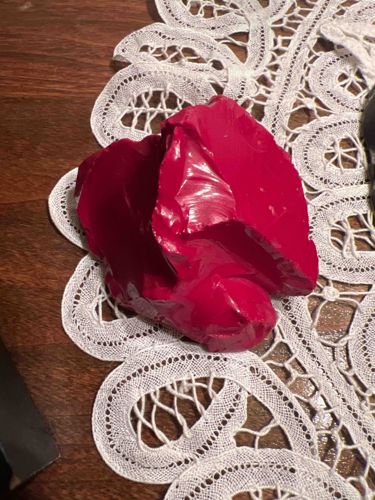
Vibrant Red Slag Glass Cullet
This item is a large, irregularly shaped chunk of opaque slag glass, also known as cullet, featuring an exceptionally vibrant and deep crimson-red hue. It measures approximately 4 to 5 inches across. The piece exhibits characteristic conchoidal fracturing, resulting in sharp, curved edges and smooth, undulated surfaces that catch the light with a high-gloss, vitreous luster. The color is exceptionally saturated and consistent throughout the visible mass, suggesting a high metallic oxide content used during the smelting process. There are no discernible maker's marks, which is typical for raw glass byproduct. The surface shows minor micro-scratches and slight dulling on the sharpest peaks, consistent with handling and storage over several decades. Such pieces were often the waste product from glass manufacturing companies like Fenton, Akro Agate, or Kanawha, likely dating from the mid-20th century (circa 1940-1970). The quality is high due to the uniformity of the color and lacks the heavy internal air bubbles often found in lower-grade slag. It serves as a striking decorative specimen or raw material for lapidary work.
AI-Generated Appraisal Disclaimer
Estimated Value
$45.00-$65.00
Basic Information
Category
Collectibles / Glassware
Appraised On
February 1, 2026
Estimated Value
$45.00-$65.00
Item Description
This item is a large, irregularly shaped chunk of opaque slag glass, also known as cullet, featuring an exceptionally vibrant and deep crimson-red hue. It measures approximately 4 to 5 inches across. The piece exhibits characteristic conchoidal fracturing, resulting in sharp, curved edges and smooth, undulated surfaces that catch the light with a high-gloss, vitreous luster. The color is exceptionally saturated and consistent throughout the visible mass, suggesting a high metallic oxide content used during the smelting process. There are no discernible maker's marks, which is typical for raw glass byproduct. The surface shows minor micro-scratches and slight dulling on the sharpest peaks, consistent with handling and storage over several decades. Such pieces were often the waste product from glass manufacturing companies like Fenton, Akro Agate, or Kanawha, likely dating from the mid-20th century (circa 1940-1970). The quality is high due to the uniformity of the color and lacks the heavy internal air bubbles often found in lower-grade slag. It serves as a striking decorative specimen or raw material for lapidary work.
Related Tags
Get Your Items Appraised
Instant estimates of your treasures with AI-powered instant appraisals