Dong Son Type Bronze Rain Drum
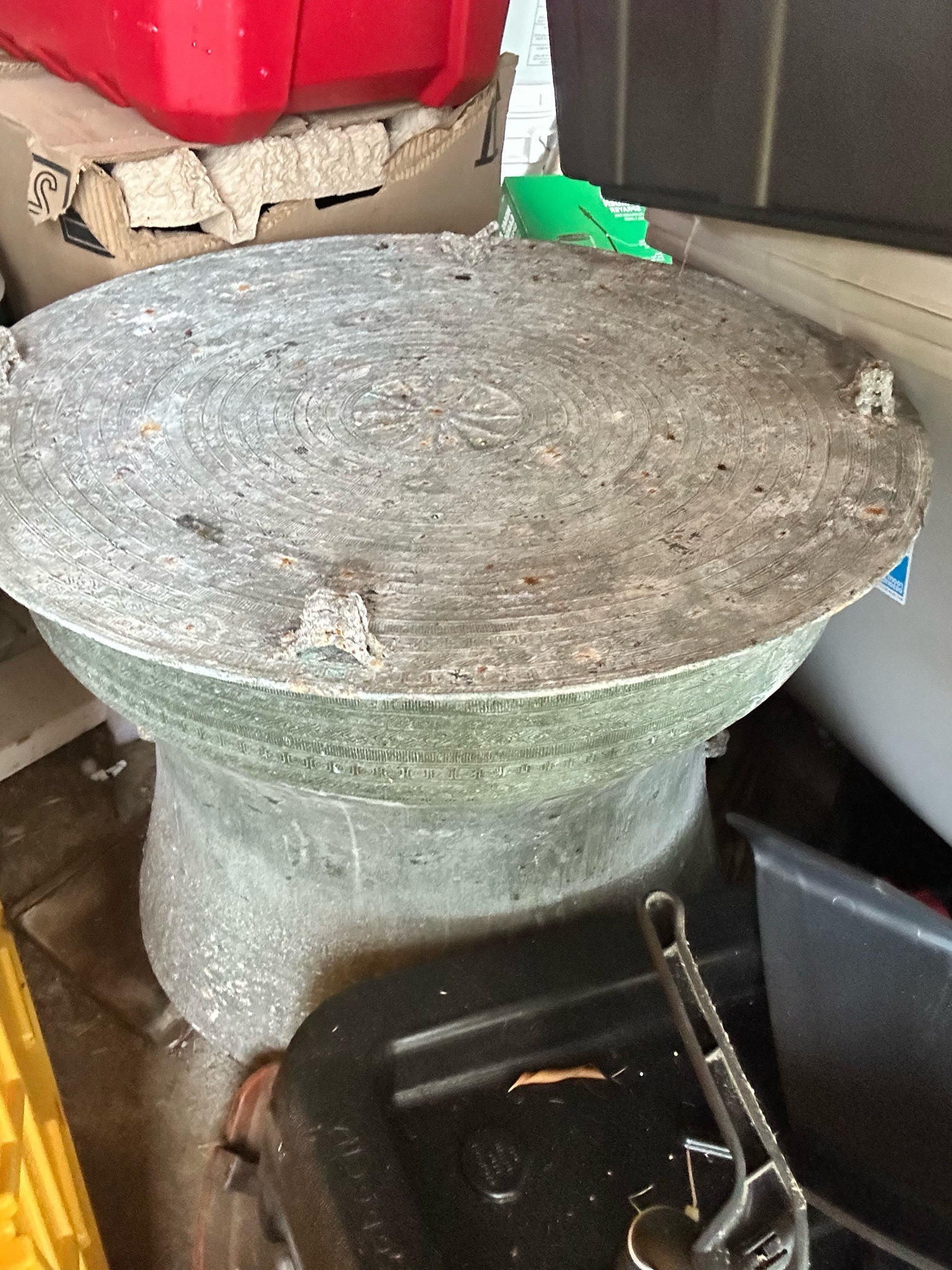
This is a large bronze 'rain drum,' a percussion instrument based on the ancient Dong Son sociocultural tradition of Southeast Asia (Vietnam/Southern China). The item features a circular top (tympanum) and a waisted, hourglass-shaped body. The tympanum is decorated with a central raised sunburst or star motif, surrounded by multiple concentric bands containing geometric patterns and stylized figures. Notably, four small three-dimensional frog ornaments are positioned equidistantly along the outer edge of the top, which historically symbolized prayers for rain. The drum exhibits a heavy green and grey verdigris patina across its entire surface, indicating age or exposure to the elements. There are visible oxidation spots, surface crusting, and some pitting, particularly on the top surface. The construction appears to be lost-wax casting. The body shows horizontal bands of decorative etching near the shoulder. While modeled after artifacts dating back to 600 BCE, this specific piece appears to be a 19th or 20th-century interpretation, often used for ritual purposes or as high-end garden furniture. The craftsmanship is detailed, though the surface wear suggests it has been stored in a damp or outdoor environment without protective casing.
AI-Generated Appraisal Disclaimer
Estimated Value
$1,800 - $2,500
Basic Information
Category
Asian Antiques / Musical Instruments
Appraised On
May 10, 2026
Estimated Value
$1,800 - $2,500
Item Description
This is a large bronze 'rain drum,' a percussion instrument based on the ancient Dong Son sociocultural tradition of Southeast Asia (Vietnam/Southern China). The item features a circular top (tympanum) and a waisted, hourglass-shaped body. The tympanum is decorated with a central raised sunburst or star motif, surrounded by multiple concentric bands containing geometric patterns and stylized figures. Notably, four small three-dimensional frog ornaments are positioned equidistantly along the outer edge of the top, which historically symbolized prayers for rain. The drum exhibits a heavy green and grey verdigris patina across its entire surface, indicating age or exposure to the elements. There are visible oxidation spots, surface crusting, and some pitting, particularly on the top surface. The construction appears to be lost-wax casting. The body shows horizontal bands of decorative etching near the shoulder. While modeled after artifacts dating back to 600 BCE, this specific piece appears to be a 19th or 20th-century interpretation, often used for ritual purposes or as high-end garden furniture. The craftsmanship is detailed, though the surface wear suggests it has been stored in a damp or outdoor environment without protective casing.
Get Your Items Appraised
Instant estimates of your treasures with AI-powered instant appraisals