AI Appraisal Estimate

AI-generated estimates · not official valuations

From the user

What was submitted

Photo and notes provided by the user — not generated by AI

Submitted item photo
Submitted photo · June 6, 2026

User's notes

No additional notes provided.

AI analysis below

AI appraisal

AI analysis & estimate

AI-Generated · Verify before acting

Everything below is generated by AI for informational purposes only. AI can make mistakes — the AI may misidentify items or misattribute them (artist, maker, brand, designer, origin, era). This is not an official valuation and should not be used for insurance, sale, tax, estate, legal, or lending purposes — or any decision requiring a certified appraisal. It is not an authoritative claim about any person, brand, or rights holder — do not share or rely on it as a factual statement about a third party. Always consult qualified professionals before making financial decisions.

Read the full disclaimer

AI Identification

·Not independently authenticated·Verify before acting

Victorian/Edwardian Era Floral and Scrolled Ceramic Plate

Dinnerware / Collectible Plate

AI Estimated Value

·Not an official valuation·Verify before acting

$40-75

As of June 6, 2026

AI Item Analysis

·AI can make mistakes·Verify before acting
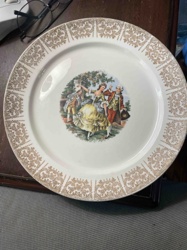
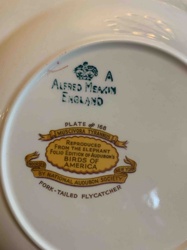
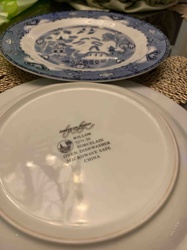
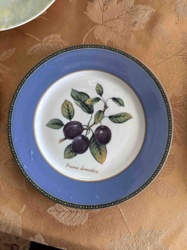
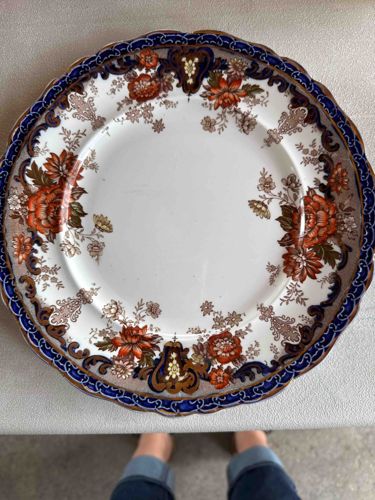
This is a decorative ceramic plate, likely earthenware or porcelain due to its opaque appearance and patterned surface. It features a predominantly white or off-white central field, surrounded by a richly decorated border. The most prominent colors in the decoration are a deep, rich cobalt blue, a vibrant terracotta or burnt orange, various shades of brown (including a reddish-brown and a lighter, golden-brown), and possibly some subtle green or olive hues in the foliage. The outer edge of the plate is scalloped or fluted, adding to its ornate character. The blue border is continuous and features an intricate, repeating scroll or ripple pattern, often seen in transferware designs. Inside this blue border, there are large, stylized floral motifs in the orange and brown palette, interspersed with more ornate, almost Paisley-like, decorative elements in browns and lighter tones. Small sprigs of leaves and flowers fill the spaces around the larger motifs. The craftsmanship appears to be of good quality, typical of mass-produced decorative ceramics from the late 19th or early 20th century. There are no obvious chips or cracks visible from the top view, though some light surface wear or minor scratching might be present on the white central area, consistent with age and use. The overall aesthetic suggests a Victorian or Edwardian era design, possibly indicative of flow blue or transfer printing techniques where patterns are applied as decals. The rich color palette and intricate design hint at an attempt to evoke luxury and a period aesthetic. No specific maker's marks are visible in the provided image; a full appraisal would require inspection of the reverse side for backstamps or impressed marks. The plate appears to be a dinner or serving plate in size.
AI Appraisal Report

·AI can make mistakes·Verify before acting
Upon visual examination of this ceramic plate, I assess its condition as good, showing no obvious chips or cracks from the presented top view. Minor surface wear on the central white field would be expected for an item of its age, consistent with gentle use or display. The detailed floral and scrolled patterns, indicative of transferware techniques, align with authentic Victorian or Edwardian era decorative ceramics. The rich cobalt blue and vibrant orange/brown palette is characteristic of mass-produced, yet aesthetically pleasing, wares from that period. Market conditions for such decorative plates, while stable for desirable patterns, are not typically high-value unless associated with a particularly renowned manufacturer or a rare pattern. Comparables in similar condition from this era generally fetch modest prices. Demand for general decorative plates of this type is moderate; they are more collectible for their aesthetic appeal and historical context than for rarity, as many such items were produced. Factors impacting value positively include the intricate design and good visible condition. However, the absence of any visible maker's marks is a significant limitation. Without inspecting the reverse for backstamps or impressed marks, I cannot definitively attribute it to a specific manufacturer, which limits its potential value as a recognized collectible. Physical examination would be crucial to confirm material (e.g., earthenware vs. true porcelain), identify any repairs not visible in the image, and primarily, to locate and authenticate any maker's marks. Provenance documentation would also enhance its value significantly, but none is provided.

Get your items appraised

Instant estimates of your treasures with AI-powered appraisals

Browse More Appraisals