AI estimate as of November 21, 2025 · verify with a professional before acting
AI-Generated · Verify before acting
Everything on this page is generated by AI for informational purposes only. AI can make mistakes — the AI may misidentify items or misattribute them (artist, maker, brand, designer, origin, era). This is not an official valuation and should not be used for insurance, sale, tax, estate, legal, or lending purposes — or any decision requiring a certified appraisal. It is not an authoritative claim about any person, brand, or rights holder — do not share or rely on it as a factual statement about a third party. Always consult qualified professionals before making financial decisions.
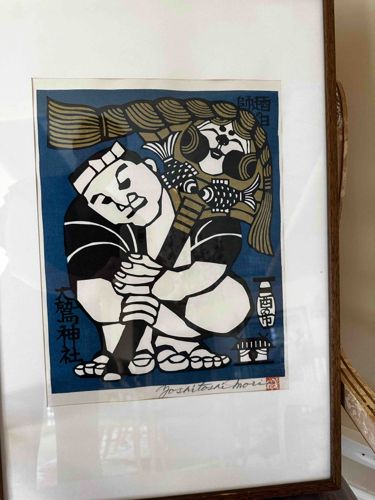
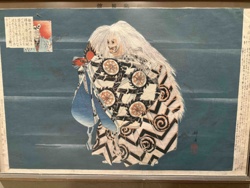
This item is a framed Japanese woodblock print, likely a stencil print (kappazuri or katazome), depicting the popular Japanese deities Ebisu and Daikoku. The print features a bold, graphic style with strong outlines and flat areas of color. The color palette is striking, dominated by a deep indigo blue background, black for outlines and details, white for figures' skin and clothing elements, and a golden-ochre color for Daikoku's hair/headdress and fish, suggesting prosperity. Ebisu, the god of fishermen and luck, is shown on the left, squatting and holding a fishing rod-like implement. Daikoku, the god of wealth and agriculture, is depicted on the right, recognizable by his large sack and mallet (though only a portion of the mallet is clearly visible). He is also carrying a fish, possibly a sea bream (tai), which is a symbol of good fortune. The figures exhibit a somewhat naive, almost folk-art style, characterized by a playful distortion of proportions and a strong sense of movement. There are Japanese characters visible in various locations; on the top right, '師西日' (possibly related to 'Shichifukujin' or 'Seven Lucky Gods' context), and on the left side, '大國神' (Daikoku-jin, or Daikoku god) '社' (Shrine). At the bottom center, a handwritten signature in Roman script reads 'yoshitoshi mori', accompanied by a red artist's seal (hanko), confirming the artist as Yoshitoshi Mori (1898-1992), a renowned Japanese folk art printmaker. The print appears to be in good condition with vibrant colors, suggesting it has been preserved from excessive light exposure. It is presented within a white mat and housed in a simple dark brown wooden frame, typical of contemporary framing practices, which adds to the overall presentation and protection of the artwork. The printing technique, bold design, and signature indicate an original artwork from the mid to late 20th century.
AI Appraisal Report
Based on my visual examination of the provided image, this is an authentic Yoshitoshi Mori woodblock print, likely a kappazuri or katazome, depicting Ebisu and Daikoku. The signature 'yoshitoshi mori' in Roman script, along with the red artist's seal (hanko), is consistent with his work. The bold, graphic style, naive figuration, and striking indigo, black, white, and golden-ochre palette are characteristic of Mori's distinctive folk art aesthetic from the mid to late 20th century. The print appears to be in very good condition; colors are vibrant, suggesting careful preservation, and there are no visible major flaws such as tears, significant creases, or extensive foxing. The contemporary framing with a mat and simple wooden frame is appropriate and protective.
Market conditions for Yoshitoshi Mori's prints are strong and stable, with consistent collector interest in his unique blending of traditional Japanese motifs with modern graphic sensibilities. Comparable works often sell within the $700-$1,500 range, depending on subject matter, size, and condition. The subject of Ebisu and Daikoku, as two of the popular Seven Lucky Gods, is highly desirable. Demand for Mori's work is moderate to high, as his prints are not exceedingly rare but are sought after by collectors of modern Japanese prints and folk art. The primary factor impacting value here is its excellent apparent condition and desirable subject matter.
Limitations: While the signature and style strongly indicate authenticity, a definitive verification would require in-person examination to assess paper quality, printing technique nuances, and the authenticity of the hanko. Provenance documentation, such as original receipts or exhibition history, would also strengthen authentication, though it's not always available for such works.