AI estimate as of July 16, 2025 · verify with a professional before acting
AI-Generated · Verify before acting
Everything on this page is generated by AI for informational purposes only. AI can make mistakes — the AI may misidentify items or misattribute them (artist, maker, brand, designer, origin, era). This is not an official valuation and should not be used for insurance, sale, tax, estate, legal, or lending purposes — or any decision requiring a certified appraisal. It is not an authoritative claim about any person, brand, or rights holder — do not share or rely on it as a factual statement about a third party. Always consult qualified professionals before making financial decisions.
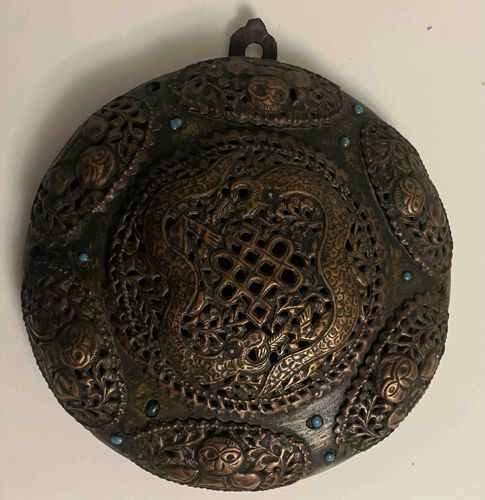
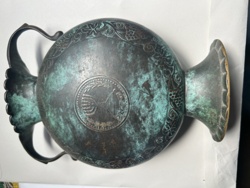
This appears to be a round, deeply embossed or carved metal plaque, likely of copper, brass, or bronze, exhibiting a rich, dark patinated finish that suggests age. The item is circular with a flat back and a small, raised loop at the top, indicating it was designed to be hung. The primary material seems to be metal, possibly with a darker base layer or 'backing' that shows through the openwork and contributes to the dimensionality. The overall color is a dark brown-bronze, with highlights on the raised areas showing a more coppery tone. There are several small, seemingly inset turquoise or teal-colored beads or stones irregularly placed around the perimeter, adding a touch of color and texture. The craftsmanship is intricate, featuring extensive repoussé and chiseled details. The central motif is dominated by two intertwined dragons or serpentine creatures, forming a circular pattern around a prominent endless knot or mystic knot symbol, which is a significant symbol in various cultures, including Tibetan Buddhism. Surrounding this central design is a complex pattern of stylized foliage and intricate scrollwork. At the top and bottom of the plaque, separated by some of the turquoise accents, are two distinct, grotesque-like faces or masks, possibly representing deities or protective spirits, each with large eyes and prominent features. The condition appears to be good for its age, with an evident patination that is desirable for such pieces, though some surface wear or minor abrasions might be present but are not clearly discernible from the image. The definition of the details suggests high-quality craftsmanship. Based on the iconography and style, it likely dates from the late 19th to mid-20th century, possibly of Tibetan or Himalayan origin.
AI Appraisal Report
Upon examining the provided image of this Tibetan/Himalayan Repoussé Metal Plaque, I assess its condition to be good for its age. The rich, dark patination is consistent with a piece that has aged naturally, and the highlights on raised areas indicate genuine wear rather than artificial aging. The intricate details of the repoussé work and the chiseled elements remain well-defined, suggesting high-quality craftsmanship and resilience over time. There are no overt signs of significant damage, repairs, or excessive surface abrasion visible from the image, which would otherwise detract from its value. The turquoise or teal-colored insets appear original and well-integrated.
Establishing definitive authenticity solely from images is challenging. While the iconography, material appearance (Plausibly copper or bronze alloy due to the visible patination), and artistic style align strongly with known Tibetan/Himalayan decorative arts and religious artifacts from the late 19th to mid-20th century, physical examination is crucial. An in-person inspection would allow me to assess the exact metal composition, the technique of the repoussé (e.g., thickness of the metal, hammer marks), the method of turquoise inset, and the quality of the reverse side. Provenance documentation, such as collection history or acquisition records, would provide invaluable context regarding its origin and journey. Furthermore, scientific testing, like XRF analysis for metal composition or microscopy for surface details, could confirm age and material authenticity.
In terms of market conditions, similar Tibetan/Himalayan ceremonial or decorative metalwork pieces, particularly those with strong religious iconography like the endless knot and dragons, are consistently sought after by collectors of Asian art and ethnographic artifacts. There is an enduring demand for genuine pieces with good craftsmanship and condition. The rarity of this specific design or its precise age is difficult to ascertain without further research into comparative examples. However, the unique combination of the central endless knot, intertwined dragons, and the two grotesque faces at the top and bottom, along with the appealing patination, renders it quite desirable.
Factors significantly impacting its value include its age (if verifiable to the earlier end of the estimated period, it would be more valuable), the quality and depth of the repoussé work, the originality of the turquoise insets, and most critically, its authenticity. The emotional and decorative appeal of such a piece also contributes to its marketability. Assuming authenticity and originality consistent with the visual cues, and given the limitations of image-based appraisal, this piece presents as a desirable and aesthetically significant item.