AI estimate as of August 9, 2025 · verify with a professional before acting
AI-Generated · Verify before acting
Everything on this page is generated by AI for informational purposes only. AI can make mistakes — the AI may misidentify items or misattribute them (artist, maker, brand, designer, origin, era). This is not an official valuation and should not be used for insurance, sale, tax, estate, legal, or lending purposes — or any decision requiring a certified appraisal. It is not an authoritative claim about any person, brand, or rights holder — do not share or rely on it as a factual statement about a third party. Always consult qualified professionals before making financial decisions.
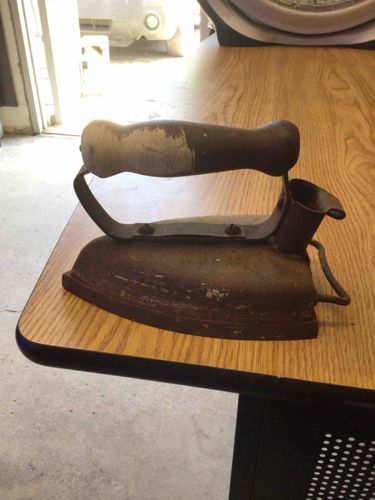
This item is an antique or vintage cast iron sad iron, also known as a flat iron or clothes iron. It features a heavy, solid cast iron body which is dark brown due to significant rust and patina, indicating its age and exposure to elements. The base of the iron is broad and flat, tapering to a point at the front, characteristic of early irons designed for pressing fabrics. The construction appears sturdy, with a solid, weighty feel. The handle assembly consists of a shaped wooden grip, which is a light, somewhat yellowish wood, possibly maple or birch, with a worn, flaking painted or lacquered surface that shows areas of darker, unpainted wood beneath. This wooden handle is attached to a metal frame that curves elegantly over the iron body. This frame is also made of metal, likely steel or wrought iron, and is secured to the main body with visible rivets or screws, two of which are clearly visible securing the wooden handle support to the curved metal piece. There is a distinctive feature at the rear of the handle assembly: a small, hollow cylindrical or cup-like element, attached to the back of the handle support. This could be a receptacle for a heating rod, indicating it might be a 'slug' or 'charcoal' iron type, although no heating element is present. The overall condition shows considerable wear consistent with age and use; the iron body is heavily rusted, and the wooden handle is chipped and discolored. Despite the rust, the structural integrity seems intact. There are no immediately discernible maker's marks or signatures visible in the image, common for many early, utilitarian irons. This style of iron was widely used before the advent of electric irons, placing its estimated age typically from the late 19th to early 20th century.
AI Appraisal Report
Upon my virtual examination of this Antique Cast Iron Sad Iron with Wooden Handle via the provided images, I've assessed its condition and potential value.
Condition: The iron displays significant rust and patina on its cast iron body, indicative of its age and prolonged exposure to elements, as described. While considerable, this level of wear is consistent with utilitarian objects of this vintage and does not necessarily detract from its antique appeal for collectors who appreciate original patina. The wooden handle, though chipped and discolored with flaking paint/lacquer, appears structurally sound. The metal frame connecting the handle to the body seems intact.
Authenticity & Limitations: The design, materials (cast iron, wood, metal frame), and construction (visible rivets/screws, pointed tapered base) are entirely consistent with late 19th to early 20th-century sad irons. The small 'cup-like' element at the rear of the handle strongly suggests this was a 'slug' or 'charcoal' type iron, further confirming its age before electric irons became widespread. This detailed feature is a strong indicator of authenticity. However, without physical inspection, I cannot confirm the integrity of all joints, the presence of hidden repairs, or the exact weight. Visual verification of maker's marks is impossible from images alone. Full authenticity verification would benefit from in-person examination to check for structural integrity, precise material composition, and any hidden repairs or restorations. Provenance documentation, if available, would significantly enhance its verifiable history.
Market Conditions & Demand: Antique sad irons are relatively common in the collectibles market, reflecting their widespread use historically. Demand is steady but generally not high, unless an iron possesses unusual features, rare maker's marks, or exceptional pristine condition. This particular iron, while authentic and complete with its original handle, falls into the 'used, rustic condition' category. Its value is primarily as a decorative antique or a piece of household history, rather than a rare artifact. Comparables in similar condition typically sell in the lower range of antique tools.
Factors Impacting Value: The heavy rust and wear on the body, combined with the distressed wooden handle, limit its higher-end valuation. Its common type, lacking unique brand identification or a particularly rare design, also keeps its value moderate. Its intrinsic appeal lies in its authentic patina and historical utility. If it had a clear, rare maker's mark or was in near-mint condition, the value would be significantly higher.
Overall, it's a solid, authentic piece of Americana reflecting a bygone era of household chores.