Victorian Era Pump Organ
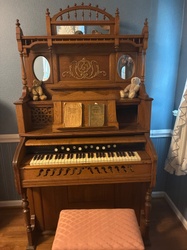
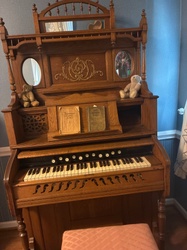
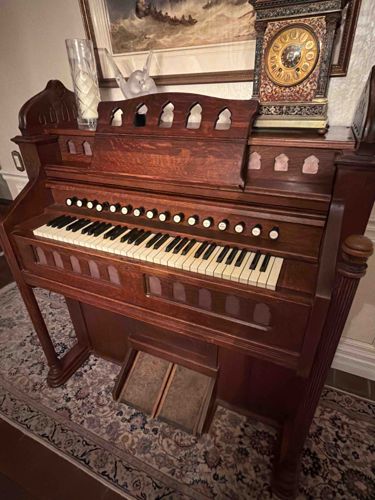
This is a Victorian-era pump organ, also known as a parlor organ or reed organ, constructed primarily of dark finished oak or walnut. The instrument features a prominent Gothic Revival influence, seen in the pointed arch fretwork on the music rack and the carved 'trefoil' or 'arch' motifs along the upper paneling and lower knee-swell housing. The keyboard consists of white ivorine or bone-plated natural keys and black accidental keys, showing some light age-related yellowing. Above the keys sits a row of thirteen cream-colored stop pulls with black lettering, used to control the airflow to various reed banks for tonal variation. The case includes turned side columns and a high backboard characteristic of late 19th-century domestic furniture design. Below the keyboard are two carpet-covered pedals used to actuate the internal bellows. While the finish appears to be in relatively good condition, there is visible wear on the pedal carpeting and light surface abrasions consistent with an item over 100 years old. The craftsmanship reflects the mass-production quality of the 1880-1900 period, intended for middle-class home entertainment and religious devotion.
AI-Generated Appraisal Disclaimer
Estimated Value
$100 - $350
Basic Information
Category
Antique Musical Instruments
Appraised On
January 25, 2026
Estimated Value
$100 - $350
Item Description
This is a Victorian-era pump organ, also known as a parlor organ or reed organ, constructed primarily of dark finished oak or walnut. The instrument features a prominent Gothic Revival influence, seen in the pointed arch fretwork on the music rack and the carved 'trefoil' or 'arch' motifs along the upper paneling and lower knee-swell housing. The keyboard consists of white ivorine or bone-plated natural keys and black accidental keys, showing some light age-related yellowing. Above the keys sits a row of thirteen cream-colored stop pulls with black lettering, used to control the airflow to various reed banks for tonal variation. The case includes turned side columns and a high backboard characteristic of late 19th-century domestic furniture design. Below the keyboard are two carpet-covered pedals used to actuate the internal bellows. While the finish appears to be in relatively good condition, there is visible wear on the pedal carpeting and light surface abrasions consistent with an item over 100 years old. The craftsmanship reflects the mass-production quality of the 1880-1900 period, intended for middle-class home entertainment and religious devotion.
Get Your Items Appraised
Instant estimates of your treasures with AI-powered instant appraisals