AI estimate as of July 15, 2025 · verify with a professional before acting
AI-Generated · Verify before acting
Everything on this page is generated by AI for informational purposes only. AI can make mistakes — the AI may misidentify items or misattribute them (artist, maker, brand, designer, origin, era). This is not an official valuation and should not be used for insurance, sale, tax, estate, legal, or lending purposes — or any decision requiring a certified appraisal. It is not an authoritative claim about any person, brand, or rights holder — do not share or rely on it as a factual statement about a third party. Always consult qualified professionals before making financial decisions.
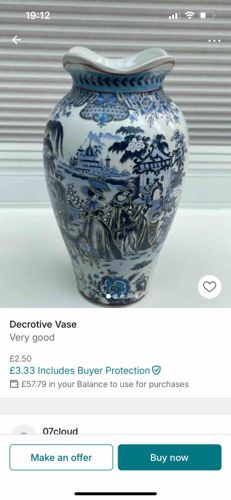
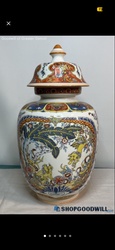
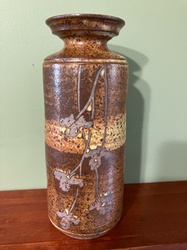
This is a blue and white transferware vase, likely made of porcelain or earthenware, featuring an orientalist or Chinoiserie landscape scene. Its form is somewhat ovoid, tapering slightly towards a narrower base and flaring at the rim. The rim itself is curvaceous, with a subtle scalloped edge that adds to its decorative appeal. The primary color scheme is white with various shades of cobalt blue, characteristic of traditional transferware. The decoration includes elaborate architectural elements such as pagodas and pavilions, lush stylized trees, and figures, possibly in traditional Chinese or Japanese attire, engaged in various activities within a landscape. There are visible floral motifs and intricate borders near the neck and base. The base has a circular blue pattern, possibly a stylized flower or a manufacturer's mark, though it is not clearly legible. The vase appears to be in 'very good' condition as noted in the provided text, suggesting minimal visible wear, chips, cracks, or repairs. The craftsmanship appears to be commercially produced, possibly from the 19th or early 20th century, given the prevalent style of blue and white pottery during that period. The overall quality seems consistent with mass-produced decorative ceramics of the era.
AI Appraisal Report
Upon examining the provided image of this Blue and White Chinoiserie Transferware Vase, I assess its condition as 'very good,' aligning with the stated description. There are no immediately apparent chips, cracks, or significant abrasions visible, and the transfer decoration appears largely intact. The style of decoration, featuring pagodas, stylized trees, and figures in a landscape, is highly characteristic of Chinoiserie transferware produced in the 19th or early 20th century. Authenticity, based solely on this image, seems plausible for a period commercial production piece. However, a definitive authentication would require in-person examination to inspect the potting, glaze consistency, foot rim, and the precise application of the transfer—details often obscured or distorted in photographs. Provenance documentation, such as original receipts or family history, would also be crucial. Scientific testing, like thermoluminescence dating, could confirm age but is typically reserved for higher-value or more contentious pieces.
In terms of market conditions, blue and white transferware, especially Chinoiserie patterns, generally maintains steady demand. However, mass-produced pieces from this era are not rare. Comparable sales for vases of similar size, condition, and decorative style typically fall within a modest range. Factors impacting value significantly include maker's marks (the circular blue pattern at the base, if legible, could be a key identifier), the exact age, originality of the decorative elements, and overall quality of the blank and transfer application. While appealing, this vase appears to be a common decorative art piece rather than a rare collectible. Its commercial nature prevents it from commanding premium prices. Without physical inspection, precise identification of the manufacturer or exact age is challenging, limiting the potential for a higher valuation.