Mid-Century End-of-Day Spatter Glass Swirl Vase
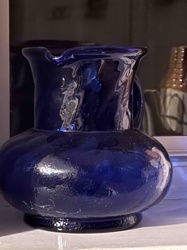
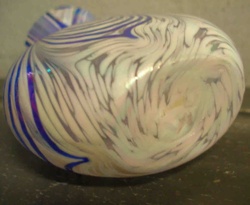
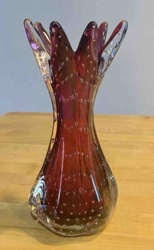
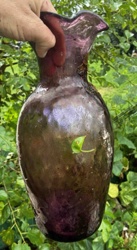
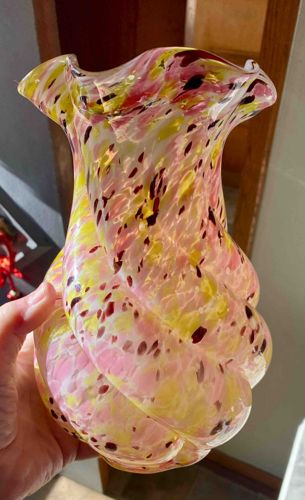
This is a hand-blown art glass vase featuring a prominent spiral or 'swirled' body construction. The piece is crafted using the 'end-of-day' or spatter glass technique, where various colors of crushed glass (frit) are incorporated into the clear molten gather. The color palette is vibrant, dominated by shades of rosy pink and sunny yellow, accented with dark burgundy or maroon speckles against a white and translucent base. The vase stands approximately 7 to 9 inches tall, exhibiting a wide, ruffled or undulating rim that flares out from a narrower neck. The body characterized by heavy molded ribs that twist diagonally around the circumference. The craftsmanship suggests a mid-20th-century origin, likely between the 1950s and 1970s, reminiscent of American makers like Kanawha or West Virginia glassworks, or possibly Bohemian imports. The glass appears to have a high-gloss finish with no visible chips, cracks, or significant surface abrasions, though shelf wear on the base is expected for its age. The organic, irregular distribution of the spatter pattern ensures that no two pieces are identical, which is a hallmark of this artisanal glass blowing style. The interior is smooth, reflecting the quality of the blowing process.

AI-Generated Appraisal Disclaimer
Estimated Value
$45.00 - $65.00
Basic Information
Category
Art Glass / Collectible Glassware
Appraised On
December 26, 2025
Estimated Value
$45.00 - $65.00
Item Description
This is a hand-blown art glass vase featuring a prominent spiral or 'swirled' body construction. The piece is crafted using the 'end-of-day' or spatter glass technique, where various colors of crushed glass (frit) are incorporated into the clear molten gather. The color palette is vibrant, dominated by shades of rosy pink and sunny yellow, accented with dark burgundy or maroon speckles against a white and translucent base. The vase stands approximately 7 to 9 inches tall, exhibiting a wide, ruffled or undulating rim that flares out from a narrower neck. The body characterized by heavy molded ribs that twist diagonally around the circumference. The craftsmanship suggests a mid-20th-century origin, likely between the 1950s and 1970s, reminiscent of American makers like Kanawha or West Virginia glassworks, or possibly Bohemian imports. The glass appears to have a high-gloss finish with no visible chips, cracks, or significant surface abrasions, though shelf wear on the base is expected for its age. The organic, irregular distribution of the spatter pattern ensures that no two pieces are identical, which is a hallmark of this artisanal glass blowing style. The interior is smooth, reflecting the quality of the blowing process.
Get Your Items Appraised
Instant estimates of your treasures with AI-powered instant appraisals