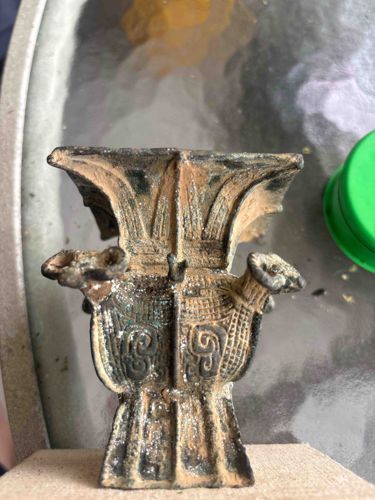
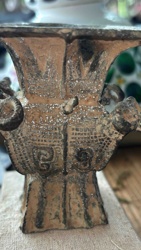
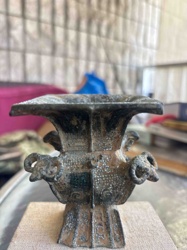
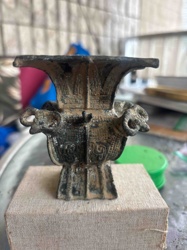
These notes were written by the person who submitted this item. Appraiser.AI has not verified them, and the AI's identification and estimate may rely on them.
AI Estimated Value
Not an official valuation
$150-300
AI estimate as of October 22, 2025 · verify with a professional before acting
AI-Generated · Verify before acting
Everything on this page is generated by AI for informational purposes only. AI can make mistakes — the AI may misidentify items or misattribute them (artist, maker, brand, designer, origin, era). This is not an official valuation and should not be used for insurance, sale, tax, estate, legal, or lending purposes — or any decision requiring a certified appraisal. It is not an authoritative claim about any person, brand, or rights holder — do not share or rely on it as a factual statement about a third party. Always consult qualified professionals before making financial decisions.
This analysis also relies on unverified notes provided by the user, which may be incomplete or inaccurate and could affect the result.
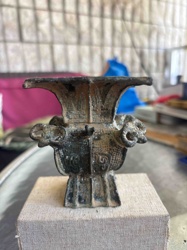
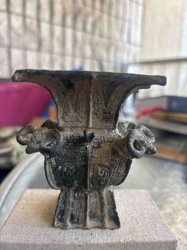
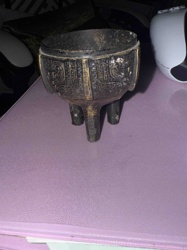
This item is a miniature Chinese bronze Gu-style beaker vessel, likely a replica or funerary item, given its size and potential lack of functional capacity for holding liquids. It is constructed from cast bronze, exhibiting a dark, mottled patina with areas of coppery-brown oxidation and some whitish deposits, possibly corrosion or remnants of burial conditions. The vessel features a classic Gu shape, characterized by a tall, slender body flaring out at both the mouth and the foot, with a constricted waist. The upper section and lower section are decorated with raised vertical flanges or ribs, typical of Shang and Zhou dynasty bronze work. The central section of the body is adorned with stylized Taotie-mask-like motifs or abstract curvilinear patterns, which appear to be variations of the 'S' or C-scroll designs. There are two protruding, loop-like or ring-shaped elements on opposing sides of the constricted waist, which are decorative rather than functional handles. The craftsmanship is evident in the detailed casting of the decorative elements, though some areas show signs of wear, particularly the raised edges and the surface texture. The overall condition suggests significant age, although proving authenticity from miniature replicas is challenging without further analysis. The piece exhibits an aged appearance, with the darker areas contrasting with the lighter, oxidized portions. This piece is likely a funerary object (mingqi) or a later decorative reproduction mimicking ancient ritual bronzes. The intricate details, despite the miniature scale, indicate careful artistry.
AI Appraisal Report
Based on my examination of the provided image, this miniature Chinese bronze Gu-style beaker vessel presents as a reproduction or funerary item, rather than an authentic ancient ritual vessel. The dark, mottled patina with coppery oxidation and whitish deposits suggests age, or an intentional aging process. The classic Gu form with flaring mouth and foot, constricted waist, and raised vertical flanges is true to ancient Shang and Zhou prototypes. The stylized Taotie-mask-like motifs on the central section, along with the decorative loop-like elements, demonstrate an appreciation for historical design. The detailed casting, even at this miniature scale, indicates a certain level of craftsmanship.
Regrettably, authenticating miniature replicas or funerary items from images alone is highly challenging. Without direct physical examination, I cannot definitively confirm the age or the exact composition of the bronze. In-person inspection would allow for tactile assessment of the patina's depth and adhesion, examination of casting marks for consistency with ancient techniques, and potentially metallurgical analysis. Provenance documentation – a detailed history of ownership – would be crucial for establishing authenticity. Scientific testing, such as X-ray fluorescence (XRF) for elemental composition or thermoluminescence (TL) dating for any ceramic core, would provide definitive age verification.
From a market perspective, miniature funerary items or later decorative reproductions of Chinese bronzes typically have a modest value. Demand exists among collectors of Asian decorative arts or funerary items, but it's not a high-demand, high-value segment compared to genuine Shang or Zhou ritual bronzes. Original ancient examples, particularly those with strong provenance and in good condition, command significant prices. This piece, however, falls into a different category. Its value is primarily aesthetic and decorative, reflecting an appreciation for historical Chinese bronze forms. Given these factors, I would place the appraisal value between $150 and $300.