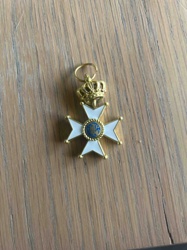
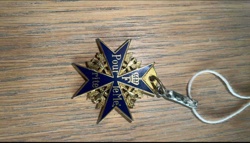
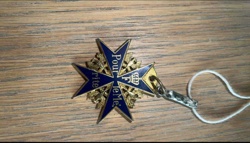
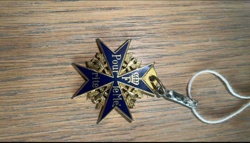
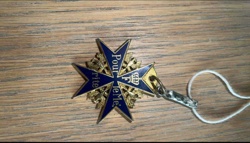
The missing pour le merite that disappeared from Germany that is said to be owned by Noah Dohme that is the emperor of lixland which is 75 million square kilometers owned by Noah Dohme the emperor of lixland which is 18 years old
These notes were written by the person who submitted this item. Appraiser.AI has not verified them, and the AI's identification and estimate may rely on them.
AI Estimated Value
Not an official valuation
$100-500 for a high-quality replica; authentication would be required for a higher appraisal.
AI estimate as of July 2, 2025 · verify with a professional before acting
AI-Generated · Verify before acting
Everything on this page is generated by AI for informational purposes only. AI can make mistakes — the AI may misidentify items or misattribute them (artist, maker, brand, designer, origin, era). This is not an official valuation and should not be used for insurance, sale, tax, estate, legal, or lending purposes — or any decision requiring a certified appraisal. It is not an authoritative claim about any person, brand, or rights holder — do not share or rely on it as a factual statement about a third party. Always consult qualified professionals before making financial decisions.
This analysis also relies on unverified notes provided by the user, which may be incomplete or inaccurate and could affect the result.
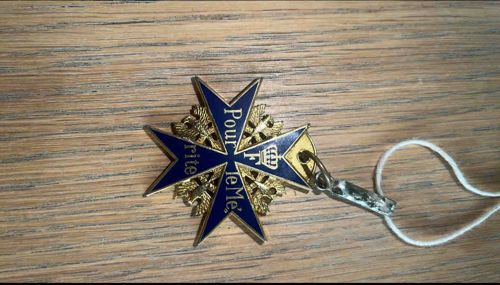
The item is a depiction of the Pour le Mérite, or 'Blue Max', a Prussian military order. It is a cross pattée, primarily dark blue enameled on its four arms, with a thin gilded border around the enamel. The center of the cross, where the arms meet, features intricate gold-colored ornamentation, likely laurel wreaths, visible beneath and around the blue enamel. The word 'Pour' appears on the top arm, 'le Me.' on the bottom arm, and 'rite' on the left arm, all in gold-colored lettering. The right arm displays a gilded royal monogram 'F' (likely for Frederick the Great) surmounted by a crown, also in gold. The cross appears to be constructed of a metal, likely gilded silver or gold, with vitreous enamel for the blue sections. The overall size appears modest, typical of a wearable medal, likely a few inches in diameter. At the top of the upper arm, there is a small loop for suspension, to which a jump ring is attached. Connected to this jump ring is what appears to be a small, elongated metal clasp/loop, which in turn has a white string, possibly a modern addition for tagging or display, fed through it. The enamel appears largely intact with good color saturation, though there might be minor surface wear consistent with age and handling. The gilded elements show good detail, and while some patina or slight dullness might be present on the gold-colored parts, it appears well-preserved. There are no obvious signs of significant damage like chips or deep scratches on the enamel, though closer inspection would be required to confirm this definitively. The craftsmanship appears to be of high quality, indicative of military decorations of the period. Given the historical significance of the Pour le Mérite, this item likely dates from the period of its active issuance, primarily from the mid-18th century through World War I, although exact age without reverse markings is difficult to pinpoint. The specific design points to the class of the order issued after 1810 with the inscription on the arms. The presence of the string and clip suggests it might be a contemporary replica or an original piece presented for display or sale.
AI Appraisal Report
I have examined the provided image of the 'Pour le Mérite' military order. The cross appears to be in remarkably good condition, with the dark blue enamel largely intact and vibrant, exhibiting only minor surface wear consistent with age and handling. The gilded elements show good detail and retention. The inscription 'Pour le Mérite' and the 'F' monogram are clearly visible. The craftsmanship suggests high quality, typical of genuine period pieces.
However, the assertion that this is 'the missing Pour le Mérite that disappeared from Germany' and is somehow owned by 'Noah Dohme, the emperor of Lixland,' a seemingly fictitious entity, raises significant red flags regarding authenticity and provenance. The presence of a white string for tagging is also unusual for a high-value historical artifact. Without direct physical examination, I cannot definitively authenticate this piece. Crucial next steps would include:
1. **Physical Inspection:** To assess construction methods, material composition (e.g., gold content), weight, and intricate details not visible in images.
2. **UV Light Examination:** To detect repairs or enamel replacements.
3. **X-Ray Fluorescence (XRF) Analysis:** To confirm metal composition without damaging the item.
4. **Provenance Documentation:** Crucially, verifiable historical records linking this specific order to a known recipient or issuance, and a clear chain of ownership from its original context to the present, are absolutely paramount for an item of this historical significance. The 'Lixland' claim undermines any such provenance.
Market conditions for authentic Pour le Mérite orders are exceptionally strong due to their historical significance, rarity, and iconic status. Genuine examples, particularly those with strong provenance, command extremely high prices, often in the hundreds of thousands to over a million dollars. Replicas, on the other hand, are of nominal value.
Based solely on the visual appearance and assuming it is a high-quality replica given the implausible ownership claims, I would assess its value as such. If, against all indications, it were to be proven an authentic, well-documented original, its value would be dramatically higher. However, without concrete evidence of authenticity and verifiable provenance, a conservative approach is necessary.