AI Appraisal Estimate

AI-generated estimates · not official valuations

From the user

What was submitted

Photo and notes provided by the user — not generated by AI

Submitted item photo
Submitted photo · May 24, 2026

User's notes

No additional notes provided.

AI analysis below

AI appraisal

AI analysis & estimate

AI-Generated · Verify before acting

Everything below is generated by AI for informational purposes only. AI can make mistakes — the AI may misidentify items or misattribute them (artist, maker, brand, designer, origin, era). This is not an official valuation and should not be used for insurance, sale, tax, estate, legal, or lending purposes — or any decision requiring a certified appraisal. It is not an authoritative claim about any person, brand, or rights holder — do not share or rely on it as a factual statement about a third party. Always consult qualified professionals before making financial decisions.

Read the full disclaimer

AI Identification

·Not independently authenticated·Verify before acting

Anglo-Indian Plantation Style Armchair

Furniture / Antique & Vintage Chairs

AI Estimated Value

·Not an official valuation·Verify before acting

$450 - $650

As of May 24, 2026

AI Item Analysis

·AI can make mistakes·Verify before acting
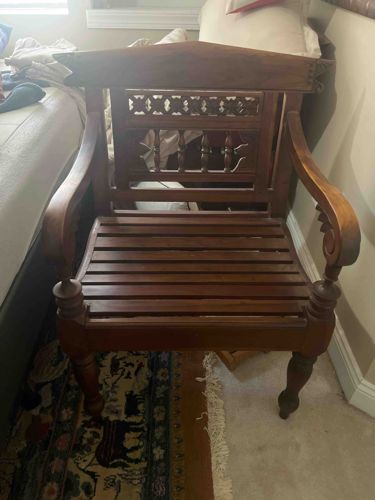
This is a hand-carved solid hardwood armchair, likely made of Sheesham or Teak, exhibiting a design that blends colonial influence with regional craftsmanship, typical of 20th-century Indian or South Asian furniture. The chair features an elaborate backrest with a pediment-style top rail, a row of pierced diamond/star fretwork, and a series of turned spindles. The horizontal slatted seat is designed for airflow in warm climates. The armrests are gracefully contoured with scrolling terminals that flow into turned supports. Condition-wise, the wood displays a warm, medium-brown patina with visible grain patterns; however, there is a notable structural issue where the front-left armrest support has separated or broken from the seat frame. Fine dust is present in the crevices of the carvings, and minor surface scratches are visible on the legs and seat slats. The turned, bulbous legs suggest a provincial interpretation of Victorian or Regency styles, often seen in 'plantation' or 'veranda' furniture. There are no visible maker's marks, which is common for artisanal pieces of this type.

AI Appraisal Report

·AI can make mistakes·Verify before acting
I have completed a visual examination of this Anglo-Indian Plantation Chair. The piece is a quintessential example of 20th-century colonial revival furniture, likely crafted from Sheesham or a local variant of Teak. The design—specifically the spindle-turned backrest, pierced fretwork, and slatted seat—is highly consistent with regional craftsmanship intended for ventilated seating in warm climates. The patina suggests moderate age, placing it in the mid-to-late 20th century rather than the early colonial period. The item's condition significantly affects its valuation. My examination reveals a critical structural failure where the front-left armrest support has detached from the seat frame. While the wood itself displays a pleasing grain, the cost of professional joinery repair and stabilization must be factored into the market value. Market demand for ‘Campaign’ or ‘Plantation’ style furniture remains steady for interior design purposes, but collectors typically seek pieces in immediately functional condition. Comparables for similar artisanal Indian armchairs in good condition typically fetch $800-$1,200 at auction. However, due to the structural damage and the absence of a maker’s mark, this specimen is valued in the lower tier of the market. Limitations: This appraisal is based solely on digital imagery. A physical inspection is required to confirm the species of wood, the presence of modern versus period fasteners (screws/nails), and the depth of the finish. To fully authenticate its age, I would need to examine the underside of the seat for tool marks or oxidation patterns that do not appear in the provided photographs. Provenance documentation, such as original purchase receipts from India or colonial estates, would be necessary to elevate the item to a 'Fine Antique' classification.

Get your items appraised

Instant estimates of your treasures with AI-powered appraisals

Browse More Appraisals