AI Appraisal Estimate

AI-generated estimates · not official valuations

From the user

What was submitted

Photo and notes provided by the user — not generated by AI

Submitted item photo
Submitted photo · May 18, 2026

User's notes

No additional notes provided.

AI analysis below

AI appraisal

AI analysis & estimate

AI-Generated · Verify before acting

Everything below is generated by AI for informational purposes only. AI can make mistakes — the AI may misidentify items or misattribute them (artist, maker, brand, designer, origin, era). This is not an official valuation and should not be used for insurance, sale, tax, estate, legal, or lending purposes — or any decision requiring a certified appraisal. It is not an authoritative claim about any person, brand, or rights holder — do not share or rely on it as a factual statement about a third party. Always consult qualified professionals before making financial decisions.

Read the full disclaimer

AI Identification

·Not independently authenticated·Verify before acting

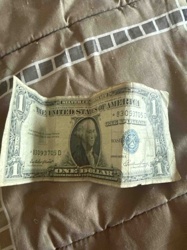
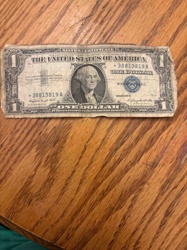
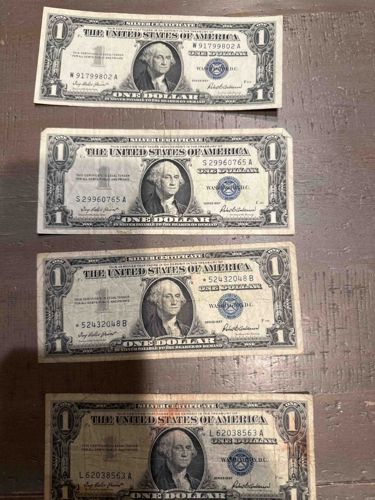
Series 1957 Blue Seal One Dollar Silver Certificates

Numismatics / US Paper Money

AI Estimated Value

·Not an official valuation·Verify before acting

$12.00-$18.00

As of May 18, 2026

AI Item Analysis

·AI can make mistakes·Verify before acting
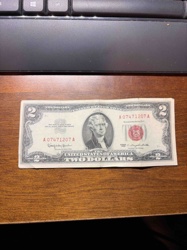
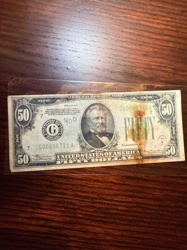
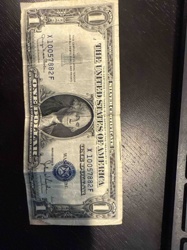
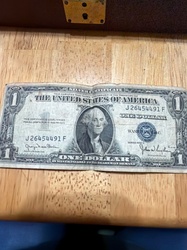
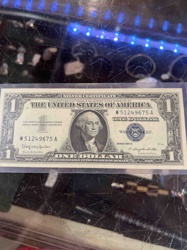
This set consists of four United States One Dollar Silver Certificates, specifically the Series 1957, 1957A, and 1957B small-size notes. These notes are distinguished by their prominent blue treasury seals and blue serial numbers (e.g., W91799802A, S29960765A, S24320488B, and L62038563A). The obverse features the iconic central portrait of George Washington, flanked by historical engraved scrollwork and the '1' denomination in each corner. These certificates were originally exchangeable for silver bullion or silver dollars at the U.S. Treasury. The physical condition across the four banknotes varies significantly: the top note appears in About Uncirculated or choice condition with sharp corners and bright paper, while the lower three notes exhibit heavy circulation wear including multiple vertical and horizontal folds, rounding of the corners, significant surface soiling, and localized staining (notably a reddish stain on the bottom note). The paper is standard linen-cotton currency stock of the mid-20th century. Notable signatures from the era include Treasury officials Ivy Baker Priest or Elizabeth Rudel Smith alongside Robert B. Anderson or C. Douglas Dillon. These notes represent the final era of the Silver Certificate before their redemption period ended in 1968.
AI Appraisal Report

·AI can make mistakes·Verify before acting
I have completed a visual examination of this lot of four Series 1957 (including A and B subsets) One Dollar Silver Certificates. Based on the provided imagery, I have assessed one note in Choice About Uncirculated (AU) condition and three notes in circulated conditions ranging from Very Good to Fine. The AU note retains strong paper crispness and original brightness, while the circulated specimens exhibit heavy vertical and horizontal creasing, significant soiling, and localized oxidation/staining on the bottom-most note. These notes appear authentic based on the engraving depth, characteristic blue ink of the Treasury seals, and period-correct signatures of Priest, Smith, Anderson, and Dillon. The market for common-date 1957 Silver Certificates is extremely liquid but reflects their status as high-mintage treasury issues. There are billions of these notes currently in the secondary market. Collectors typically seek 'Star' notes or high-grade uncirculated examples; circulated 'Blue Seals' generally trade at a modest premium over face value. Current auction and retail comparables suggest a value of $4-$6 for the top crisp note and $2-$3 each for the circulated examples. Note that this appraisal is limited by the digital nature of the inspection. While the notes show no immediate red flags, full authentication would require physical examination under UV light to verify the red and blue security fibers and tactile inspection of the intaglio printing. Provenance was not provided, though it is rarely required for these common denominations. To certify these as 'Gem' or for professional grading, submission to PMG or PCGS would be necessary, though the cost of grading would likely exceed the market value of the individual notes.

Get your items appraised

Instant estimates of your treasures with AI-powered appraisals

Browse More Appraisals