AI estimate as of July 12, 2025 · verify with a professional before acting
AI-Generated · Verify before acting
Everything on this page is generated by AI for informational purposes only. AI can make mistakes — the AI may misidentify items or misattribute them (artist, maker, brand, designer, origin, era). This is not an official valuation and should not be used for insurance, sale, tax, estate, legal, or lending purposes — or any decision requiring a certified appraisal. It is not an authoritative claim about any person, brand, or rights holder — do not share or rely on it as a factual statement about a third party. Always consult qualified professionals before making financial decisions.
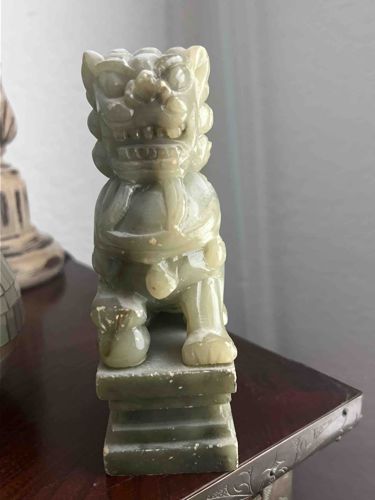
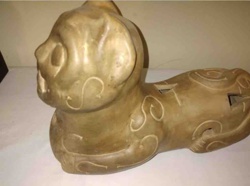
This is a small, carved sculpture of a mythical Chinese guardian lion, often referred to as a 'Foo Dog' or 'Foo Lion'. The carving is executed in a light green, possibly celadon-toned, material that appears to be a type of jade or soapstone, consistent with traditional Asian carving materials. The specific shade is an opaque, muted green with lighter, almost translucent areas, suggesting natural variations in the stone. The lion is depicted in a seated position, looking forward with an open mouth and visible teeth, and a somewhat fierce yet stylized expression. It features a mane, eyebrows, and a beard rendered with incised and carved details. The body is compact and robust, with a stylized tail visible at the back. The carving sits on an integrated, rectangular stepped base, which is also carved from the same material.
Physical characteristics include its relatively small stature, suitable for display on a tabletop or shelf. The craftsmanship indicates hand-carving, evident from the varying depths of cuts and slight irregularities in the symmetrical elements, adding to its artisanal appeal. There are visible signs of wear and age, including some chipping and loss of material, particularly on the edges of the stepped base and possibly on some raised features of the lion itself. The surface appears somewhat dull rather than highly polished, suggesting either its original finish or a natural patina developed over time. The estimated age is likely 20th century, possibly mid-to-late, given the style and material common in decorative arts from that period. There are no readily discernible maker's marks or signatures visible in the provided image. The overall quality is good for a decorative piece of this type, despite the minor condition issues, and it captures the distinctive aesthetic of traditional Chinese guardian figures.
AI Appraisal Report
Upon visual examination of the provided image, I assess this Chinese Guardian Lion carving as a decorative piece likely from the 20th century, possibly mid-to-late. The material appears to be a type of jade or soapstone, consistent with traditional Asian carving. While the light green, celadon-toned hue is attractive, without physical inspection or gemological testing, I cannot definitively confirm the precise stone or its quality. The craftsmanship suggests hand-carving, evident in the slight irregularities contributing to its artisanal character.
Regarding condition, there are visible signs of wear and age, including chipping and material loss, particularly on the edges of the stepped base and potentially on raised features of the lion. The dull surface finish suggests either its original presentation or a naturally developed patina. These condition issues, while impacting pristine aesthetics, are not severe enough to render the piece unsalvageable for display and are typical for an object of this presumed age and material.
Authenticity, based solely on imagery, is limited. While the style aligns with common decorative arts of the period, definitive authentication would require in-person examination to ascertain carving techniques, tool marks, and material properties more thoroughly. Provenance documentation (e.g., origin of acquisition, previous ownership) would significantly enhance authenticity verification. Scientific testing, such as spectroscopy for material analysis, would be necessary for precise identification of the stone and confirmation of its age, which could impact intrinsic value if it proves to be a rarer or older jade type. Without these, I must appraise based on its decorative merit and perceived market.
In terms of market conditions, similar decorative Chinese guardian lion carvings in semi-precious stone or soapstone from the 20th century exhibit moderate demand, primarily within the realm of Asian decorative arts collectors or those seeking accent pieces. They are not exceedingly rare, and the market is generally stable for such items. Comparables include other carved stone "Foo Dogs" of similar size and decorative quality, which typically sell in the hundreds of dollars, rather than thousands, unless they possess exceptional age, provenance, artistic merit, or material value (e.g., highly desirable antique jade).
The primary factors impacting value here are the decorative appeal, presumed age, and condition. The lack of a definitive material identification (e.g., specific jade type), precise age verification, or artist signature/provenance limits its upper market potential. The minor damage also slightly reduces its value compared to an unblemished example.
Considering these factors, I believe its value lies in its aesthetic and decorative appeal as a period piece, rather than as a high-value antique or fine art sculpture.