AI Appraisal Estimate

AI-generated estimates · not official valuations

From the user

What was submitted

Photo and notes provided by the user — not generated by AI

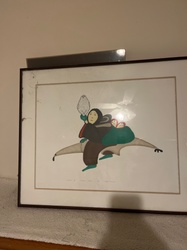
Submitted item photo
Submitted photo · June 27, 2026

User's notes

No additional notes provided.

AI analysis below

AI appraisal

AI analysis & estimate

AI-Generated · Verify before acting

Everything below is generated by AI for informational purposes only. AI can make mistakes — the AI may misidentify items or misattribute them (artist, maker, brand, designer, origin, era). This is not an official valuation and should not be used for insurance, sale, tax, estate, legal, or lending purposes — or any decision requiring a certified appraisal. It is not an authoritative claim about any person, brand, or rights holder — do not share or rely on it as a factual statement about a third party. Always consult qualified professionals before making financial decisions.

Read the full disclaimer

AI Identification

·Not independently authenticated·Verify before acting

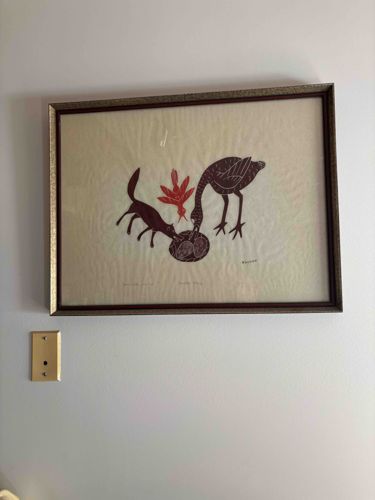
Kananginak Pootoogook 'Greedy Wolf' Stonecut Print

Fine Art - Inuit Print

AI Estimated Value

·Not an official valuation·Verify before acting

$1,500 - $2,200

As of June 27, 2026

AI Item Analysis

·AI can make mistakes·Verify before acting
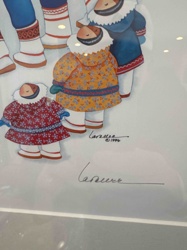
This item is a framed Inuit stonecut print titled 'Greedy Wolf' by the renowned Cape Dorset artist Kananginak Pootoogook. The artwork depicts a stylistic scene of a wolf and a goose competing over a shared food source, rendered in a two-tone palette of dark charcoal and earthen red. The figures exhibit the characteristic simplified, rhythmic forms and decorative interior patterning associated with the West Baffin Eskimo Co-operative printmaking style. The medium is stonecut on a textured, off-white handmade paper, which displays visible rippling and undulation, likely due to improper mounting or humidity changes over time. The print includes pencil inscriptions at the bottom edge, identifying the title, technique, and artist's signature in syllabics and English. It is housed in a simple, dark wood frame with a metallic inner lip. There are signs of aging, including yellowing of the paper and minor scuffing on the frame's edges. Kananginak (1935–2010) was a pivotal figure in the development of Northern graphic arts, and this piece likely dates from the late 1960s to mid-1970s, representing a classic period of Inuit artistic expression.
AI Appraisal Report

·AI can make mistakes·Verify before acting
I have virtually examined this stonecut print, 'Greedy Wolf,' attributed to the late Kananginak Pootoogook. The piece exhibits the bold graphic sensibility and intricate interior textures synonymous with the Cape Dorset (Kinngait) printmaking tradition of the 1960s-70s. The presence of standard syllabic signatures and Western pencil annotations suggests a genuine period edition from the West Baffin Eskimo Co-operative. The two-tone palette is emblematic of the era's aesthetic and remains highly desirable among collectors of Arctic art. However, my visual inspection reveals notable condition concerns. The visible rippling and undulation of the paper substrate indicate the piece is likely not mounted using acid-free archival methods, and the yellowing suggests light-strike damage or acidic mat burn. These factors negatively impact the value, as restoration by a paper conservator may be required. Market demand for Kananginak’s early work remains strong, particularly for animal-human interactions; comparable auction results for his mid-century stonecuts typically range from $1,200 to $3,000 depending on condition and edition size. This appraisal assumes the work is a genuine edition and not a later reproduction. Definitive authentication requires physical inspection to verify the paper’s watermark, ink depth, and the absence of mechanical dot patterns. Provenance documentation, such as the original Igloo Tag or a gallery bill of sale, would be necessary to verify the chain of ownership and secure the upper end of the valuation range. A physical examination out of the frame is recommended to assess the structural integrity of the paper edges and the extent of foxing or acidity.

Get your items appraised

Instant estimates of your treasures with AI-powered appraisals

Browse More Appraisals