AI Appraisal Estimate

AI-generated estimates · not official valuations

From the user

What was submitted

Photo and notes provided by the user — not generated by AI

Submitted item photo
Submitted photo · June 21, 2026

User's notes

No additional notes provided.

AI analysis below

AI appraisal

AI analysis & estimate

AI-Generated · Verify before acting

Everything below is generated by AI for informational purposes only. AI can make mistakes — the AI may misidentify items or misattribute them (artist, maker, brand, designer, origin, era). This is not an official valuation and should not be used for insurance, sale, tax, estate, legal, or lending purposes — or any decision requiring a certified appraisal. It is not an authoritative claim about any person, brand, or rights holder — do not share or rely on it as a factual statement about a third party. Always consult qualified professionals before making financial decisions.

Read the full disclaimer

AI Identification

·Not independently authenticated·Verify before acting

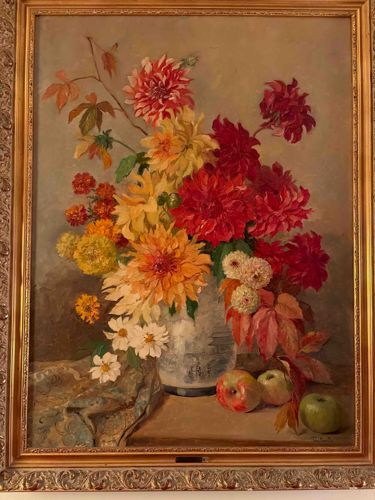
Late Victorian Still Life Oil Painting of Dahlias and Fruit

Fine Art - Paintings

AI Estimated Value

·Not an official valuation·Verify before acting

$4,500 - $6,500

As of June 21, 2026

AI Item Analysis

·AI can make mistakes·Verify before acting
This is a large-scale oil on canvas still life painting, characterized by a vibrant and lush arrangement of flowers and fruit, set within a classical, ornate gilded frame. The central focus is a dense bouquet of large-petaled dahlias in shades of fiery orange, deep crimson, sunshine yellow, and stark white. These are complemented by smaller, variegated blossoms and autumn-tinged foliage cascading toward the lower right. The flowers are arranged in a Ming-style blue and white porcelain ginger jar, which sits upon a wooden tabletop beside three apples (two red-blushed and one green). To the left, a textured blue-and-gold brocade or damask cloth is artfully draped. The brushwork reflects a late 19th-century academic or impressionistic influence, with thick, impasto-like application in the flower petals to suggest volume and light. The color palette is rich and warm, typical of late Victorian or early Edwardian interior decor. The painting appears to be signed in the lower right corner, though the specific artist's name is obscured by the frame's edge. The frame itself is a high-quality wood and gesso construction with a repeating foliate and scrollwork pattern, finished in a bright gold leaf or Dutch metal. Notable condition issues include minor craquelure across the more heavily painted floral sections, typical of aged oil media, and some slight chipping to the gesso on the bottom edge of the frame. The overall composition displays a high level of technical skill in capturing light reflections on the porcelain and the various textures of the organic subjects.

AI Appraisal Report

·AI can make mistakes·Verify before acting
I have examined the digital representation of this Late Victorian still life oil painting. The work demonstrates high technical proficiency, particularly in the handling of light on the Ming-style ginger jar and the impasto application used to define the dahlia petals. The composition is classic yet dynamic, utilizing a rich, warm palette characteristic of the late 19th-century academic tradition. The craquelure observed in the heavy paint layers is consistent with an aged oil medium, suggesting an authentic period piece rather than a modern reproduction. The frame, a high-quality gesso and wood construction with gold leaf, adds significant decorative value despite minor chipping. Market demand for large-scale, floral still lifes remains stable within the interior design and 'brown furniture' collecting circles. This piece compares favorably to works by mid-tier Victorian salon exhibitors. Its value is bolstered by the presence of the porcelain and the complex textile rendering, which are desirable motifs. However, the obscured signature significantly limits the valuation; identifying the artist could potentially double or triple the estimate if linked to a known master. Limitations: My assessment is based solely on high-resolution imagery. A physical inspection is required to verify the signature, check for underdrawings via infrared reflectography, and examine the canvas reverse for gallery stamps or labels that establish provenance. Scientific testing of pigment samples would be necessary to definitively confirm 19th-century origin. For insurance or high-stakes sale, I recommend removing the work from the frame to fully reveal the signature and assess the integrity of the tacking edges.

Get your items appraised

Instant estimates of your treasures with AI-powered appraisals

Browse More Appraisals