Lower Paleolithic Style Chert Large Hand Axe / Scraper
Antiquities & Artifacts

Lower Paleolithic Style Chert Large Hand Axe / Scraper

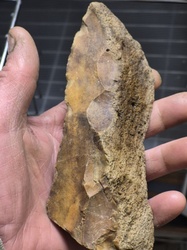
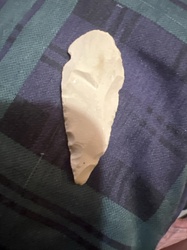
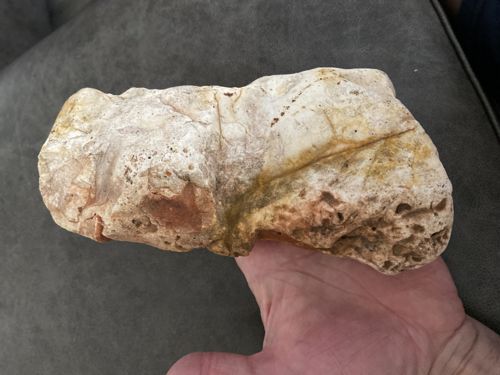
This specimen is an unrefined lithic object identified as a large hand axe or scraper, measuring approximately 7 inches by 3.25 inches. Constructed from light-colored chert, the object displays a rugged, utilitarian form characteristic of early tool development. The material exhibits a range of earthy tones, including off-white, cream, and areas of reddish-brown iron staining or cortical remnants. Its physical construction shows signs of rudimentary percussion flaking, creating a heavy, bifacial-like grip that tapers toward potential working edges. Notably, the surface serves as a record of its environment, showing significant weathering, varying degrees of patina, and deep natural pitting or vesicles on the right-hand side. While described as a Lower Paleolithic tool, its discovery in Guthrie, Oklahoma, suggests a North American context where such heavy lithic industries are more commonly associated with the Paleoindian or Archaic periods. The item shows no modern signatures or maker's marks, relying instead on its raw craftsmanship and heavy, solid mass to indicate its use as a multi-purpose chopping or scraping implement. Condition is consistent with an archaeological find, featuring worn edges and significant mineral accretions without recent fractures.
Estimated Value

$40 - $75

Basic Information

Category

Antiquities & Artifacts

Appraised On

February 20, 2026

Estimated Value

$40 - $75

Additional Details Provided By Owner

User Provided Information

Lower Paleolithic chert large hand axe scraper found in Guthrie OK measuring 7" x 3.25"

Item Description

This specimen is an unrefined lithic object identified as a large hand axe or scraper, measuring approximately 7 inches by 3.25 inches. Constructed from light-colored chert, the object displays a rugged, utilitarian form characteristic of early tool development. The material exhibits a range of earthy tones, including off-white, cream, and areas of reddish-brown iron staining or cortical remnants. Its physical construction shows signs of rudimentary percussion flaking, creating a heavy, bifacial-like grip that tapers toward potential working edges. Notably, the surface serves as a record of its environment, showing significant weathering, varying degrees of patina, and deep natural pitting or vesicles on the right-hand side. While described as a Lower Paleolithic tool, its discovery in Guthrie, Oklahoma, suggests a North American context where such heavy lithic industries are more commonly associated with the Paleoindian or Archaic periods. The item shows no modern signatures or maker's marks, relying instead on its raw craftsmanship and heavy, solid mass to indicate its use as a multi-purpose chopping or scraping implement. Condition is consistent with an archaeological find, featuring worn edges and significant mineral accretions without recent fractures.
Get Your Items Appraised

Instant estimates of your treasures with AI-powered instant appraisals

Browse More Appraisals