Pablo Picasso Tapestry after 'Le Déjeuner sur l’herbe'
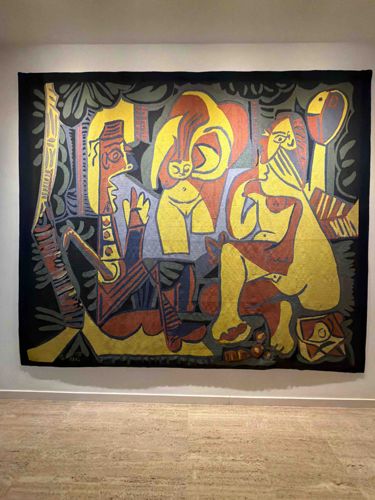
This is a monumental wall tapestry measuring approximately 310 cm by 260 cm (3.10 x 2.60 meters), representing a textile interpretation of Pablo Picasso's 'Le Déjeuner sur l’herbe' series. The composition is a Cubist reimagining of Édouard Manet's famous 1863 painting. The tapestry features three central figures executed in bold, flattened geometric forms against a dark, contrasting background. One figure on the right seated, a standing nude figure in the center-left, and a seated male figure on the far left. The color palette is dominated by ochre yellows, earthy browns, and deep blues, separated by thick black outlines characteristic of Picasso's later graphic style. The construction appears to be a heavy wool flat-weave, possibly produced by a renowned workshop such as Dürrbach (Studio René Dürrbach in Cavalaire), with whom Picasso collaborated for large-scale textile translations of his work. The quality of the stitching suggests professional hand-weaving, intended to replicate the artist's brushwork in a tactile medium. No significant fading or fiber loss is visible from the image, suggesting the piece has been well preserved and kept out of direct sunlight. The lower left corner appears to contain a woven signature and date, which is typical for authorized tapestry editions from the mid-20th century (likely 1960s based on when Picasso focused on this specific theme). The scale of this piece indicates it was designed for a public space or a highly significant private collection.
AI-Generated Appraisal Disclaimer
Estimated Value
$40,000 - $60,000
Basic Information
Category
Fine Art Textiles / Tapestries
Appraised On
January 19, 2026
Estimated Value
$40,000 - $60,000
Additional Details Provided By Owner
User Provided Information
Picasso, tapiz de 3,10 x 2,60 m
Item Description
This is a monumental wall tapestry measuring approximately 310 cm by 260 cm (3.10 x 2.60 meters), representing a textile interpretation of Pablo Picasso's 'Le Déjeuner sur l’herbe' series. The composition is a Cubist reimagining of Édouard Manet's famous 1863 painting. The tapestry features three central figures executed in bold, flattened geometric forms against a dark, contrasting background. One figure on the right seated, a standing nude figure in the center-left, and a seated male figure on the far left. The color palette is dominated by ochre yellows, earthy browns, and deep blues, separated by thick black outlines characteristic of Picasso's later graphic style. The construction appears to be a heavy wool flat-weave, possibly produced by a renowned workshop such as Dürrbach (Studio René Dürrbach in Cavalaire), with whom Picasso collaborated for large-scale textile translations of his work. The quality of the stitching suggests professional hand-weaving, intended to replicate the artist's brushwork in a tactile medium. No significant fading or fiber loss is visible from the image, suggesting the piece has been well preserved and kept out of direct sunlight. The lower left corner appears to contain a woven signature and date, which is typical for authorized tapestry editions from the mid-20th century (likely 1960s based on when Picasso focused on this specific theme). The scale of this piece indicates it was designed for a public space or a highly significant private collection.
Get Your Items Appraised
Instant estimates of your treasures with AI-powered instant appraisals