These notes were written by the person who submitted this item. Appraiser.AI has not verified them, and the AI's identification and estimate may rely on them.
AI Estimated Value
Not an official valuation
$150-250
AI estimate as of July 8, 2025 · verify with a professional before acting
AI-Generated · Verify before acting
Everything on this page is generated by AI for informational purposes only. AI can make mistakes — the AI may misidentify items or misattribute them (artist, maker, brand, designer, origin, era). This is not an official valuation and should not be used for insurance, sale, tax, estate, legal, or lending purposes — or any decision requiring a certified appraisal. It is not an authoritative claim about any person, brand, or rights holder — do not share or rely on it as a factual statement about a third party. Always consult qualified professionals before making financial decisions.
This analysis also relies on unverified notes provided by the user, which may be incomplete or inaccurate and could affect the result.
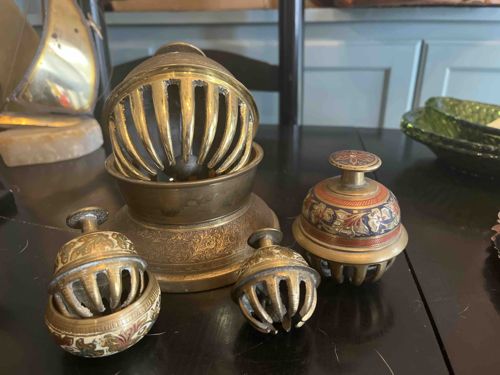
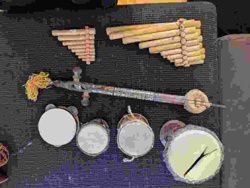
The image displays a collection of 'elephant claw bells' or 'ghungroos,' which are traditional Indian ankle bells, often used in classical Indian dance forms or for adorning temple elephants. The term 'claw bell' likely refers to their unique construction where the resonating chamber is formed by a series of curved, claw-like brass strips joined at the top and bottom. There are four distinct items visible, varying in size and decorative detail. The largest bell, prominently centered, appears to be made of solid brass with a deep, warm patina, indicating age and possible extensive handling. Its construction features numerous vertical, curved slats that create the bell's cage-like form. The base of this largest bell shows intricate etched or embossed patterns, possibly floral or geometric motifs, typical of Indian metalwork. No explicit maker’s marks are discernible, but the craftsmanship suggests traditional methods.
Two smaller bells, positioned to the lower left, exhibit similar claw-like construction but are notable for their additional enamel or painted decoration. These smaller bells feature bands of colorful enamel work, primarily in red, black, and cream/gold tones, with intricate floral or foliage designs. One of these smaller bells also has a detailed figural motif (possibly an elephant or other animal) incorporated into its painted band, enhancing its decorative appeal and suggesting a higher level of artistry. The finials on top of the bells are rounded and appear to be cast brass, possibly serving as attachment points. The overall condition of the bells suggests a vintage to antique age, with visible wear and uneven patination consistent with brass objects that have been used or handled over time. There are no obvious signs of significant damage like cracks or major repairs, although minor surface abrasions and tarnishing are present, contributing to their antique character. The variation in size and decoration indicates they might be a set or individual pieces acquired over time, representing different levels of embellishment and purpose, from ceremonial to decorative.
AI Appraisal Report
Upon examining the images of these Indian brass elephant claw bells, also known as ghungroos, I have assessed them as fine examples of traditional Indian metalwork, likely dating to the early to mid-20th century. The collection consists of four bells of varying sizes and decorative complexity. The large, unadorned bell showcases classic craftsmanship with a desirable, warm patina indicating its age and use. The smaller bells are particularly noteworthy due to their detailed enamel (meenakari) work, featuring floral and faunal motifs that elevate their artistic and monetary value. The overall condition appears good for their age, with expected wear, minor abrasions, and tarnishing that contribute to their antique character. There are no visible signs of major cracks or repairs.
The market for antique Indian decorative arts remains steady, with particular interest in well-crafted, authentic items. Comparable sales for similar vintage brass ghungroos with detailed enamel work typically range from $40 to $100 per bell, depending on size, artistry, and condition. The larger, simpler bell holds value in its size and authenticity. The presence of a set with varied decoration enhances the collection's appeal.
However, this appraisal is limited by the use of images alone. A definitive authentication requires in-person examination to assess the quality of the brass alloy, examine the enamel work under magnification for signs of modern replication, and determine the construction techniques. Without provenance documentation or metallurgical analysis, it is impossible to confirm the exact age or origin with certainty. A physical inspection would be necessary to fully verify authenticity and rule out modern reproductions.