AI estimate as of July 22, 2025 · verify with a professional before acting
AI-Generated · Verify before acting
Everything on this page is generated by AI for informational purposes only. AI can make mistakes — the AI may misidentify items or misattribute them (artist, maker, brand, designer, origin, era). This is not an official valuation and should not be used for insurance, sale, tax, estate, legal, or lending purposes — or any decision requiring a certified appraisal. It is not an authoritative claim about any person, brand, or rights holder — do not share or rely on it as a factual statement about a third party. Always consult qualified professionals before making financial decisions.
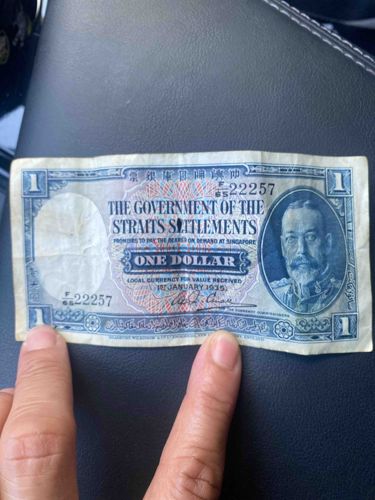
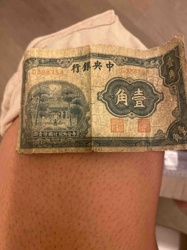
This item is a historical banknote, specifically a 'One Dollar' note issued by 'The Government of the Straits Settlements'. The dominant color scheme of the note is blue, featuring various shades of blue ink printing on what appears to be a light-colored paper, likely cream or off-white, which has aged over time. The physical dimensions appear to be consistent with standard currency notes of its era, roughly rectangular.
Notable features include the prominent text 'THE GOVERNMENT OF THE STRAITS SETTLEMENTS' at the top center, and 'ONE DOLLAR' below it in a framed box. To the right of the central text is a portrait of a distinguished-looking man with a mustache, likely a British monarch or governor, within an oval frame. The serial number 'F_22257' is visible in two locations: at the top right quadrant and the bottom left quadrant, both horizontally arranged. The numerical value '1' is present in all four corners of the note.
A key distinguishing element is the date '1ˢᵗ JANUARY 1935' printed near the bottom center, indicating its precise manufacturing date. Below this date is a signature. The note also states 'PROMISES TO PAY THE BEARER ON DEMAND AT SINGAPORE' and 'LOCAL CURRENCY FOR VALUE RECEIVED'. Chinese characters are visible along the top border above 'THE GOVERNMENT', and another line of text, possibly in another Southeast Asian language or Arabic script, runs along the bottom border.
The visible condition shows significant signs of wear consistent with circulation for a banknote of its age. There are multiple creases and folds across the entire surface. The paper exhibits areas of discoloration and general toning from age and handling. While no major tears or repairs are immediately evident, the soft creases suggest the paper might be somewhat brittle. The edges appear to be worn but are largely intact. The ink remains mostly vibrant, though some areas may show slight fading. The craftsmanship appears to be typical of government-issued currency of the period, demonstrating precision in printing and engraving, with intricate patterns forming the background and borders to deter counterfeiting. This note falls into the colonial or pre-World War II period of currency issuance for British territories in Southeast Asia.
AI Appraisal Report
I have examined the provided image of the One Dollar Banknote from the Straits Settlements, dated 1st January 1935. Based on my visual assessment, the note appears to be authentic for its era, exhibiting characteristics consistent with known issues of this type: the distinctive portrait, 'ONE DOLLAR' framing, serial number placement ('F_22257'), and multilingual text including Chinese characters and other scripts. The craftsmanship aligns with government-issued currency of the period.
The condition, as described, is consistent with a circulated note of its age. Multiple creases, folds, discoloration, and general toning indicate significant wear. While no major tears are evident, the noted 'soft creases' suggest increased brittleness. This condition would be graded around Fine (F) to Very Fine (VF).
Market conditions for Straits Settlements banknotes, especially pre-WWII issues, are generally stable, driven by collectors specializing in British Commonwealth, Asian currency, and historical colonial notes. While not exceedingly rare, a 1935 issue in Fine to Very Fine condition commands reasonable demand. Factors impacting value include the visible wear, but also the historical significance as a transitional currency prior to World War II and the Japanese occupation.
It is crucial to note that this appraisal is based solely on the provided image and description. Full authentication requires in-person examination to verify paper type, watermark (if any), printing details, and to detect any sophisticated counterfeits or repairs. Provenance documentation could further enhance confidence. Scientific testing, such as ink analysis, would be necessary for definitive authentication, though typically reserved for higher-value items.