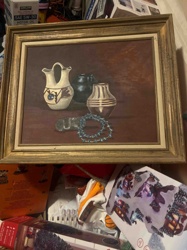
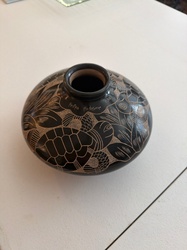
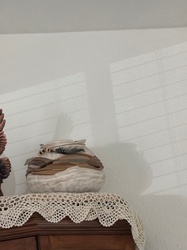
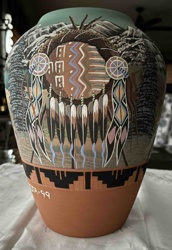
Santa Clara or Hopi bowl from the early 20 th century
These notes were written by the person who submitted this item. Appraiser.AI has not verified them, and the AI's identification and estimate may rely on them.
AI Estimated Value
Not an official valuation
$1,800-2,500
AI estimate as of October 3, 2025 · verify with a professional before acting
AI-Generated · Verify before acting
Everything on this page is generated by AI for informational purposes only. AI can make mistakes — the AI may misidentify items or misattribute them (artist, maker, brand, designer, origin, era). This is not an official valuation and should not be used for insurance, sale, tax, estate, legal, or lending purposes — or any decision requiring a certified appraisal. It is not an authoritative claim about any person, brand, or rights holder — do not share or rely on it as a factual statement about a third party. Always consult qualified professionals before making financial decisions.
This analysis also relies on unverified notes provided by the user, which may be incomplete or inaccurate and could affect the result.
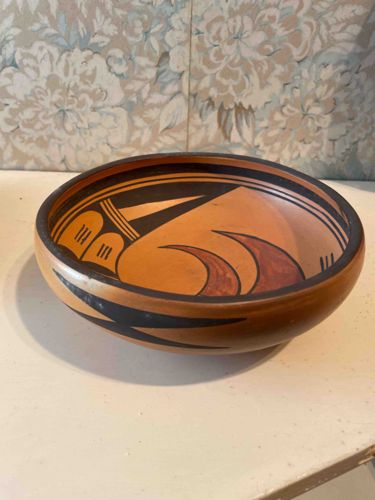
This is a hand-coiled and painted pottery bowl, likely from a Pueblo tradition such as Santa Clara or Hopi, characteristic of the early 20th century. The bowl exhibits a warm, earthy terracotta or orange-brown base color, indicative of the natural clay used. The decoration is applied in a contrasting dark black pigment, possibly historically derived from mineral pigments or organic materials, along with an oxidized reddish-brown secondary color within some of the painted design elements. The overall shape is shallow and wide, with a subtly rounded base that suggests it was designed for display or serving. The interior features a complex, asymmetrical design dominated by large black geometric shapes and curvilinear forms. Notable elements include black bands outlining the rim and defining segments of the interior. Within these segments, stylized motifs, possibly representing clouds, feathers, or other natural elements, are visible. One section features a repeating pattern of three vertical lines within a stylized shape. The exterior of the bowl is decorated with a band of distinctive black geometric patterns, specifically visible are triangular or stepped motifs, which are common in Southwestern pottery. The craftsmanship appears to be traditional hand-built pottery with a burnished or polished finish, giving it a soft sheen. Visible condition issues include expected age-related wear, light surface abrasions, and minor inconsistencies in the paint application, which are typical for handmade objects of this age. There are no obvious signs of chips, cracks, or repairs in the visible areas, suggesting good preservation for its estimated age. The unique combination of colors and traditional motifs point to a piece with cultural significance and skilled artistry.
AI Appraisal Report
Based on my visual examination of the provided image, this Native American Pueblo Pottery Bowl, attributed to either Santa Clara or Hopi traditions and dated to the early 20th century, presents as a well-preserved and historically significant piece. The hand-coiled construction, warm terracotta base, and contrasting dark black and reddish-brown pigments are consistent with the described traditions and age. I observe a good overall condition with expected age-related wear, light surface abrasions, and minor paint inconsistencies, all typical for a handmade artifact of this vintage. Crucially, I see no immediate indications of chips, cracks, or repairs, which significantly enhances its value.
The complex, asymmetrical interior design featuring geometric and curvilinear forms, along with the distinct exterior band of stepped motifs, demonstrates skilled artistry and adherence to traditional Pueblo aesthetic principles. Demand for authentic early 20th-century Native American pottery, particularly pieces with strong artistic merit and in good condition, remains consistent. Comparables for pieces of this era and quality from known Pueblo traditions typically fall within this range, influenced by the specific artist (if identifiable), exact Pueblo origin, and overall condition.
However, it is imperative to state that full authenticity verification is limited by image-based appraisal. While the stylistic elements strongly suggest authenticity, definitive attribution to a specific Pueblo (Santa Clara or Hopi) and verification of the early 20th-century origin would require in-person examination. A physical inspection would allow me to assess the clay body, temper, firing consistency, and pigment composition with greater certainty. Furthermore, any verifiable provenance documentation (e.g., family history, old sales receipts, collection records) would significantly solidify its authenticity and potentially increase its market value. Scientific testing, such as thermoluminescence dating, could also confirm the age if warranted. Without these, while the piece appears genuine, this appraisal rests on the strong visual evidence presented.