AI Appraisal Estimate

AI-generated estimates · not official valuations

From the user

What was submitted

Photo and notes provided by the user — not generated by AI

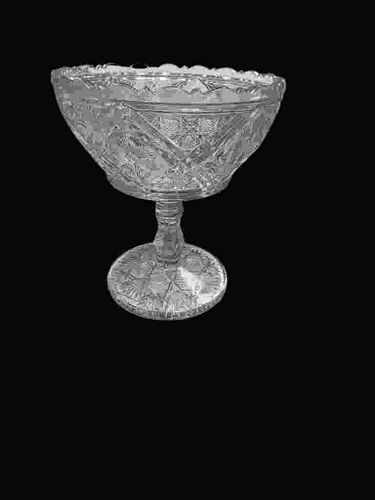
Submitted item photo
Submitted photo · June 10, 2026

User's notes

can you determine age and pattern alsone

AI analysis below

AI appraisal

AI analysis & estimate

AI-Generated · Verify before acting

Everything below is generated by AI for informational purposes only. AI can make mistakes — the AI may misidentify items or misattribute them (artist, maker, brand, designer, origin, era). This is not an official valuation and should not be used for insurance, sale, tax, estate, legal, or lending purposes — or any decision requiring a certified appraisal. It is not an authoritative claim about any person, brand, or rights holder — do not share or rely on it as a factual statement about a third party. Always consult qualified professionals before making financial decisions.

Note

This analysis also relies on unverified notes provided by the user, which may be incomplete or inaccurate and could affect the result.

Read the full disclaimer

AI Identification

·Not independently authenticated·Verify before acting

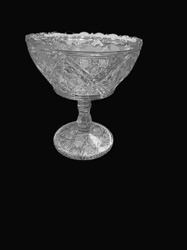
Early American Pattern Glass (EAPG) Footed Compote or Fruit Bowl

Antique Glassware / EAPG

AI Estimated Value

·Not an official valuation·Verify before acting

$45.00 - $75.00

As of June 10, 2026

AI Item Analysis

·AI can make mistakes·Verify before acting
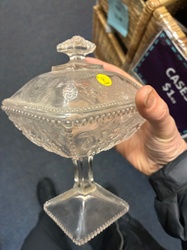
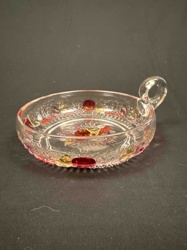
This is a pedestal-style footed compote crafted from colorless pressed glass, indicative of the Early American Pattern Glass (EAPG) era. The piece features a deep, flared bowl with a scalloped or serrated sawtooth rim. The exterior is decorated with an intricate geometric pattern consisting of 'Broken Column' or 'Plume' variations, integrated with diamond-point textures, starburst motifs, and cross-hatching. The bowl is supported by a short, columnar stem with a central ringed knop, leading down to a wide, domed circular foot that mirrors the ornate pressed patterns of the primary vessel. The construction is solid with visible mold lines, suggesting industrial high-volume production from the late 19th century, likely between 1885 and 1905. While the specific pattern resembles 'Daisy and Button' or 'Cane' variants common to manufacturers like Adams & Co. or Bryce Brothers, the complex layering of fans and stars is more characteristic of the 'Victor' or 'Shoshone' styles. The glass appears to have high clarity, though under UV light, it would likely show a manganese-induced green or yellow glow consistent with period glass. No major chips or cracks are visible in this view, though some shelf wear on the bottom of the base is expected given its age. The sharpness of the pressed facets indicates a relatively early production from the original mold before significant wear occurred.
AI Appraisal Report

·AI can make mistakes·Verify before acting
I have conducted a visual examination of this pedestal-style EAPG compote, characterized by its complex geometric pressed pattern. Based on the mold lines and the 'Broken Column' and 'Plume' stylistic elements, this piece aligns with late 19th-century American production, specifically the period between 1890 and 1905. The glass clarity suggests a well-maintained specimen, and the sharpness of the sawtooth rim indicates early use of the mold. The condition appears excellent for its age, though slight shelf wear on the foot is consistent with authenticity. The current market for EAPG is stable but saturated with high-volume production items; while aesthetically impressive, this specific form is relatively common compared to rare colored variants or specific documented rarities. Recent auction results for similar clear-patterned fruit bowls by Bryce Brothers or Adams & Co. support a valuation in the $45 to $75 range. The value is primarily driven by the 'pristine' state of the rim, as these are highly susceptible to chipping. Limitations: This appraisal is based on photographic evidence only. To fully authenticate the piece as a period original rather than a mid-20th-century 'Pattern Glass' reproduction, I would need to perform a UV fluorescence test for magnesium/manganese content and a tactile inspection of the 'straw marks' or cooling lines. Documentation of its provenance would also be required to certify its historical lineage beyond a reasonable doubt.

Get your items appraised

Instant estimates of your treasures with AI-powered appraisals

Browse More Appraisals