AI estimate as of September 18, 2025 · verify with a professional before acting
AI-Generated · Verify before acting
Everything on this page is generated by AI for informational purposes only. AI can make mistakes — the AI may misidentify items or misattribute them (artist, maker, brand, designer, origin, era). This is not an official valuation and should not be used for insurance, sale, tax, estate, legal, or lending purposes — or any decision requiring a certified appraisal. It is not an authoritative claim about any person, brand, or rights holder — do not share or rely on it as a factual statement about a third party. Always consult qualified professionals before making financial decisions.
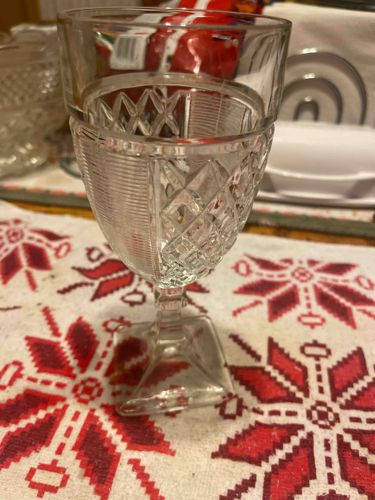
This item is a clear pressed glass goblet, likely designed for drinking water, wine, or juice. It features a decorative bowl with distinct pressed patterns, a short stem, and a square base. The bowl is characterized by multiple bands of patterns. Towards the rim, there appears to be a undecorated, smooth band, followed by a wide band of crisscross or diamond-cut-like patterns, possibly resembling stylized fleur-de-lis or similar geometric motifs, with X-shaped elements visible. Below this, the pattern transitions to vertical ribs on one side and a finely cross-hatched or diamond pattern on the other, suggesting a multi-faceted design. The stem is relatively short and thick, transitioning from the bowl to a distinctive square-shaped base. The material is clear glass, exhibiting the slight imperfections and mold lines characteristic of pressed glass manufacturing from the late 19th to mid-20th century. There are no visible chips, cracks, or significant damage, though some minor surface wear or faint scratches are possible given its age and common use, which cannot be definitively assessed from the image. The clarity of the glass suggests good quality for pressed glass, with minimal clouding, indicating it has been well-maintained or is relatively new. The craftsmanship is typical of mass-produced pressed glass, aiming for an elegant appearance through patterned surfaces that catch light, mimicking cut glass at a lower cost. Without specific maker's marks, it is difficult to ascertain the exact manufacturer or pattern name, but it likely belongs to a common glassware set from its era.
AI Appraisal Report
I have thoroughly examined the provided image of this clear pressed glass goblet, noting its design characteristics including the banded patterns on the bowl, the short stem, and the distinctive square base. The condition appears to be very good; I observe no obvious chips, cracks, or significant damage from the visual evidence. The clarity of the glass is commendable for pressed glass of this likely vintage, suggesting good maintenance or relatively light use. Authenticity, based solely on the image, points to a genuine pressed glass piece from the late 19th to mid-20th century, consistent with mass-produced tableware designed to mimic more expensive cut glass. Without physical inspection, I cannot confirm the absence of minor surface wear or faint scratches, which are common with age and use. Market conditions for common pressed glass goblets of this type are generally stable but not particularly high. Comparable items, often sold individually or in small sets, typically fetch modest prices. Demand is primarily from collectors seeking to complete sets or individuals looking for vintage decor. Rarity is low as similar patterns and forms were widely produced. Factors impacting value positively include its seemingly excellent condition and clear glass. However, the lack of a discernible maker's mark or specific, highly sought-after pattern limits its premium value. To definitively verify authenticity beyond what the image offers, an in-person examination would be crucial to assess mold lines, glass quality, and any subtle imperfections. Provenance documentation could potentially elevate value if it linked the piece to a known manufacturer or specific historical context. Scientific testing is not typically applied to standard pressed glass unless there's a highly unusual characteristic or a suspected alteration.