AI Appraisal Estimate

AI-generated estimates · not official valuations

From the user

What was submitted

Photo and notes provided by the user — not generated by AI

Submitted item photo
Submitted photo · June 4, 2026

User's notes

No additional notes provided.

AI analysis below

AI appraisal

AI analysis & estimate

AI-Generated · Verify before acting

Everything below is generated by AI for informational purposes only. AI can make mistakes — the AI may misidentify items or misattribute them (artist, maker, brand, designer, origin, era). This is not an official valuation and should not be used for insurance, sale, tax, estate, legal, or lending purposes — or any decision requiring a certified appraisal. It is not an authoritative claim about any person, brand, or rights holder — do not share or rely on it as a factual statement about a third party. Always consult qualified professionals before making financial decisions.

Read the full disclaimer

AI Identification

·Not independently authenticated·Verify before acting

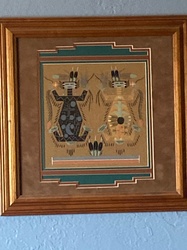
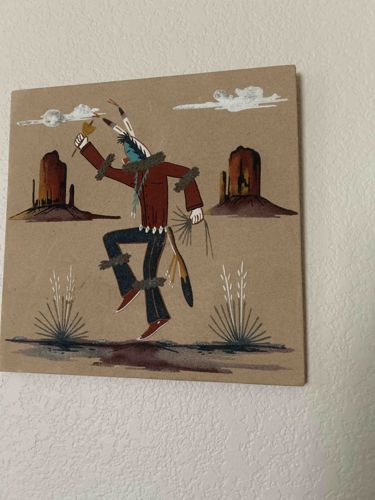
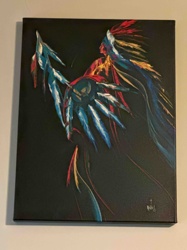
Navajo Sand Painting of a Gan Dancer

Native American Folk Art & Paintings

AI Estimated Value

·Not an official valuation·Verify before acting

$450 - $650

As of June 4, 2026

AI Item Analysis

·AI can make mistakes·Verify before acting
This is a traditional Navajo (Diné) sand painting depicting a Gan Dancer (Mountain Spirit Dancer) against a southwestern landscape with mesa formations and cacti. The artwork is created using various colors of naturally ground sand, stones, and earth pigments applied onto a rigid composition board. The central figure is shown in a dynamic ritual dance pose, wearing a distinct mask with a blue face, a red tunic, dark trousers, and traditional brown moccasins. The dancer is adorned with fur-like textures on the neck and joints, representing evergreens or ceremonial hide, and holds traditional ritual implements including a feather or wand. The color palette consists of earthy reds, deep blues, charcoal blacks, and stark whites, all set against a neutral tan background. The background features two stylized mesas and white clouds, suggesting a desert horizon. The craftsmanship shows fine control of the sand medium, particularly in the thin lines of the plants and the intricate details of the dancer's costume. While no signature is visible in the current view, such works are frequently signed or titled on the reverse. The piece appears to be in good vintage condition with no significant loss of sand or 'bleeding' of pigments, suggesting it has been kept in a stable environment. This style of secular sand painting emerged in the mid-20th century as a way for artists to share Navajo iconography commercially while preserving the sanctity of traditional healing sand paintings.
AI Appraisal Report

·AI can make mistakes·Verify before acting
I have virtually examined this mid-to-late 20th-century Navajo (Diné) sand painting depicting a Ga'an (Mountain Spirit) Dancer. Based on visual inspection, the piece demonstrates professional-level craftsmanship, characterized by fine-line control in the earth-pigment application and a sophisticated use of natural mineral tones. The condition appears 'Good to Very Good' for a vintage secular piece; I observe no significant granular shedding or moisture-related bleeding, though light surface oxidation of the pigments is expected for its age. The market for mid-century Navajo secular art remains stable, with demand driven by regional collectors and enthusiasts of Southwestern iconography. This specific piece benefits from a complex composition including landscape elements (mesas and clouds), which typically commands a higher premium than solo figures on plain backgrounds. A comparable sale of a similar-sized work by a known artist (such as David Villaseñor or those from the Shiprock area) would range between $400 and $800 depending on signature and provenance. This appraisal is limited by the lack of physical inspection. I cannot definitively verify the adhesive stability or provide a chemical analysis of the pigments to confirm the absence of synthetic dyes. Full authentication requires an in-person examination of the backing board to detect maker marks or a studio stamp, and provenance documentation linking it to a specific artist or trading post. If the reverse reveals a signature from a noted master, the valuation could increase by 50% or more.

Get your items appraised

Instant estimates of your treasures with AI-powered appraisals

Browse More Appraisals