AI estimate as of September 30, 2025 · verify with a professional before acting
AI-Generated · Verify before acting
Everything on this page is generated by AI for informational purposes only. AI can make mistakes — the AI may misidentify items or misattribute them (artist, maker, brand, designer, origin, era). This is not an official valuation and should not be used for insurance, sale, tax, estate, legal, or lending purposes — or any decision requiring a certified appraisal. It is not an authoritative claim about any person, brand, or rights holder — do not share or rely on it as a factual statement about a third party. Always consult qualified professionals before making financial decisions.
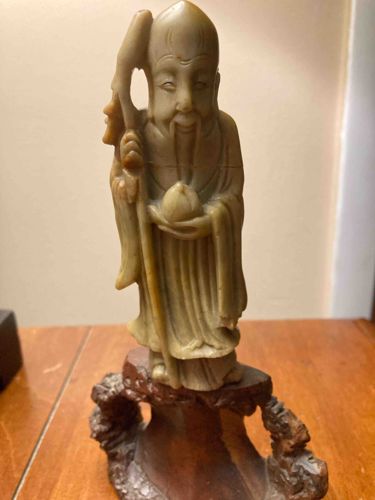
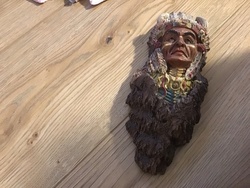
This item is an intricately carved statue depicting Shouxing (also known as Shou Lao or Sau), the Chinese God of Longevity. The statue is crafted from a light olive-green to yellowish-brown soapstone or a similar soft stone, exhibiting natural variations in color and subtle veining inherent to the material. The figure stands upright, holding a large peach (a symbol of immortality) in both hands in front of his belly. He is recognizable by his characteristically elongated forehead, bald head, and long, wispy beard, rendered with fine incised lines suggesting individual strands. His face shows a benevolent expression with smiling eyes and a wide, friendly grin. He wears a flowing robe that drapes elegantly, with folds and creases well-defined, suggesting movement and volume. Adorned on his left side, he carries a long staff, which appears to be gnarled and possibly includes a small stylized face or figure near the top, although the detail is somewhat obscured. The carving technique is detailed, particularly in the facial features, hands, and robe, indicating a good level of craftsmanship. The statue is mounted on a separate, darker brown, possibly carved wood or composite material base, designed to resemble a natural rock formation or gnarled tree roots, adding stability and complementing the figure. There are no visible chips, cracks, or significant damage to the stone figure, and it appears to be in good condition with a natural patina consistent with its material and potential age. Without specific maker's marks, it is challenging to pinpoint an exact manufacturing date, but the style suggests it could be mid-20th century or earlier, characteristic of Chinese folk art or decorative carvings intended for display. The overall quality of the carving, symmetry, and material selection contributes to its aesthetic appeal.
AI Appraisal Report
Based on my visual examination of the provided image, this intricately carved Shouxing God of Longevity statue is in very good condition. The material appears to be a well-carved soft stone such as soapstone, exhibiting natural variations in color and subtle veining. The detailing, especially in the facial features, hands, and the flowing robes, indicates a good level of craftsmanship characteristic of decorative folk art. The benevolent expression and traditional iconography, including the elongated forehead, bald head, long beard, and the prominent peach, are all consistent with depictions of Shouxing. The absence of visible chips, cracks, or significant damage to the stone figure is a positive factor. The separate base, designed to resemble natural rock or roots, complements the figure nicely and adds to its stability and presentation.
From the image alone, authentication relies on stylistic queues. The style suggests a mid-20th century or possibly earlier origin, common for such decorative Chinese carvings. Without a physical examination, I cannot definitively confirm the exact stone type (e.g., specific type of soapstone often used for these carvings) or detect minute repairs or restorations. Market demand for such decorative stone carvings of traditional Chinese deities is generally moderate. While not overtly rare, well-executed pieces like this one maintain a steady interest among collectors of Asian decorative arts. Comparable sales of similar-sized and quality soapstone or soft stone Shouxing figures typically fall within the $200-$500 range, depending on rarity, age, and intricacy. The lack of specific maker's marks is typical for this type of folk art and does not inherently detract from its value, but it does make precise dating challenging. To fully authenticate and confirm the age, an in-person examination, potentially including material analysis, and a review of any available provenance documentation would be essential. These steps would allow for a more precise dating and confirmation of originality, which could impact the higher end of its value range.