The Artists of Sioux Pottery Front Row: (left to right) Leonard Little Thunder, Yvonne Brave Hawk, Jeanne High Elk Back Row: (left to right) Richard Underbaggage, Red Feather, Marilyn Eaglehawk, Scott Jones-Little Thunder Sioux Symbols & Designs Warpath Reinforcements Getting Ready for Battle Battle Scene Enemy Surrounding Main Figure AAA Mountain Range Sun Unity Mountains & Arrowheads Eye of the Great Spirit Mountain Paha Sapa Black Hills" Peace Pipe Most Sacred Symbol Crossed Arrows Friendship TeePee "tipi" Indian Home Poths Crossing nemits on Frens Horses Killed in Battle Four Directions Seasons of the Year Color in Square Denotes Season "T|TM Rain Good Crops Bear Tracks ПППП Plenty Crame Lightning Surttness 3 Eagle Leadership E Fortress On the Alert
These notes were written by the person who submitted this item. Appraiser.AI has not verified them, and the AI's identification and estimate may rely on them.
AI Estimated Value
Not an official valuation
$350-550
AI estimate as of October 8, 2025 · verify with a professional before acting
AI-Generated · Verify before acting
Everything on this page is generated by AI for informational purposes only. AI can make mistakes — the AI may misidentify items or misattribute them (artist, maker, brand, designer, origin, era). This is not an official valuation and should not be used for insurance, sale, tax, estate, legal, or lending purposes — or any decision requiring a certified appraisal. It is not an authoritative claim about any person, brand, or rights holder — do not share or rely on it as a factual statement about a third party. Always consult qualified professionals before making financial decisions.
This analysis also relies on unverified notes provided by the user, which may be incomplete or inaccurate and could affect the result.
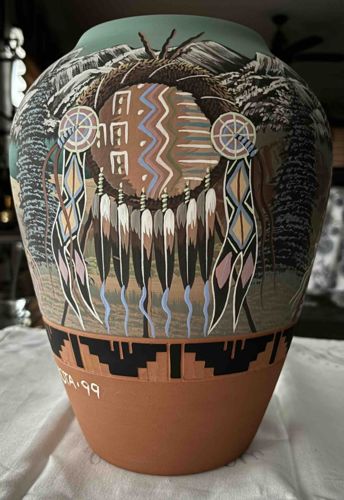
This is a hand-painted ceramic vase or pottery piece, likely made from terracotta or a similar earthenware, given the unglazed reddish-brown base. The piece has a classic Southwestern or Native American pottery form, wider at the top and gradually tapering towards the base. The overall height appears substantial, possibly 10-14 inches, though exact dimensions are not provided. The upper two-thirds of the vase are elaborately decorated with a multi-colored mural-style painting, meticulously applied. The color palette includes earthy tones such as various shades of brown, green, blue, white, black, and hints of pale pink or purple.
The central motif on the painted section is a large, rounded shield-like object, possibly representing a rawhide shield or drum, adorned with traditional geometric patterns, including a prominent zigzag line and block designs. Flanking this central element are two circular dreamcatcher-like designs with radiating spokes, attached to which are several painted feathers, intricately detailed with varying colors and textures. The background of this main scene depicts a natural landscape, possibly mountains with snow-capped peaks or a forest, conveying a sense of depth. Below the painted mural, there is a band of black geometric patterns, specifically a stepped or 'mesa' design, common in Native American art. Below this patterned band, the pottery reverts to its natural, unglazed reddish-brown color, forming the lower third of the piece.
On the unglazed section, near the base, white hand-painted marks are visible: 'S.T.A.99'. This likely represents a signature or initials of the artist ('S.T.A.') and the year of creation ('99', presumably 1999). The craftsmanship appears to be of good quality, with attention to detail in the painting and the intricate designs. There are no immediately visible condition issues such as chips, cracks, or significant wear, and the colors appear vibrant, suggesting good preservation or recent creation. The piece embodies a strong cultural narrative through its symbolism, aligning with the provided context of 'Sioux Symbols & Designs'.
AI Appraisal Report
I have examined the provided image of the Sioux Pottery Vase with Native American Imagery. The piece presents as a hand-painted ceramic vase, likely earthenware, featuring a traditional form that tapers towards the base. Visually, the condition appears excellent; the colors are vibrant, and there are no discernible chips, cracks, or significant wear. The intricate detail in the multi-colored mural-style painting, featuring a central shield motif, dreamcatcher-like designs, and feathers against a landscape background, suggests good craftsmanship. The geometric band with a stepped 'mesa' design further enhances its cultural representation.
Authenticity, based solely on imagery, is strongly indicated by the visible hand-painted marks 'S.T.A.99' on the unglazed base. This signature, likely an artist's initials and a creation year (1999), aligns with the practice of individual artists within Native American pottery traditions. The imagery itself, including elements like shields, feathers, and geometric patterns, resonates with the provided 'Sioux Symbols & Designs' context, lending further credence to its purported origin.
In terms of market conditions, contemporary Native American pottery and crafts, particularly signed pieces from known tribal artists, hold a stable market. While this piece showcases quality artistry, without specific artist recognition (beyond 'STA') or detailed provenance, it falls into a broader category of decorative arts. Demand for such pieces is generally consistent among collectors of Native American art and Southwestern decor. Rarity is difficult to ascertain without knowing the artist's full body of work or production numbers, but similar hand-painted contemporary pottery pieces are not exceedingly rare.
Factors significantly impacting value include the artful execution, good condition, and apparent cultural authenticity. However, the lack of known provenance or a verifiable signature from a highly recognized artist within the Sioux pottery community limits its top market value. For full authentication, an in-person examination would be crucial to assess clay type, paint application, and overall construction, and to scrutinize the signature for consistency with other known works by S.T.A., if identifiable. Documentation connecting the piece directly to one of the listed Artists of Sioux Pottery would significantly increase its value.