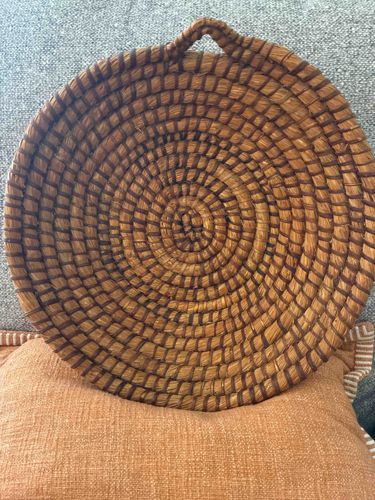
Hand-Coiled African Fiber Basket Tray
Folk Art / Basketry

Hand-Coiled African Fiber Basket Tray

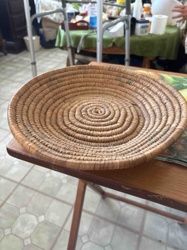
This item is a circular, hand-coiled basket tray, likely originating from Sub-Saharan Africa. It is constructed using a traditional coiling technique where a bundle of inner foundation grass or reed is tightly wrapped and stitched with split botanical fibers, possibly sisal or raffia. The tray features a rich, tonal brown color palette with visible variations in the fiber hue, suggesting the use of organic dyes or natural aging of the plant material. The construction starts from a tight central spiral and radiates outward in uniform rows. A notable feature is the integrated small loop handle at the top edge, indicating it was designed for wall hanging or as a functional carry-all. The craftsmanship shows high-quality tension in the stitching, though some minor fraying and dryness of the fibers are visible, particularly near the outer rim, consistent with a vintage piece. The patina is even, suggesting it has been kept in a dry environment. This style is often associated with the late 20th century, typically found in artisan markets from regions like Rwanda or Ethiopia. There are no visible maker's marks, which is standard for such handcrafted folk art.
Estimated Value

$45-85

Basic Information

Category

Folk Art / Basketry

Appraised On

February 11, 2026

Estimated Value

$45-85

Item Description

This item is a circular, hand-coiled basket tray, likely originating from Sub-Saharan Africa. It is constructed using a traditional coiling technique where a bundle of inner foundation grass or reed is tightly wrapped and stitched with split botanical fibers, possibly sisal or raffia. The tray features a rich, tonal brown color palette with visible variations in the fiber hue, suggesting the use of organic dyes or natural aging of the plant material. The construction starts from a tight central spiral and radiates outward in uniform rows. A notable feature is the integrated small loop handle at the top edge, indicating it was designed for wall hanging or as a functional carry-all. The craftsmanship shows high-quality tension in the stitching, though some minor fraying and dryness of the fibers are visible, particularly near the outer rim, consistent with a vintage piece. The patina is even, suggesting it has been kept in a dry environment. This style is often associated with the late 20th century, typically found in artisan markets from regions like Rwanda or Ethiopia. There are no visible maker's marks, which is standard for such handcrafted folk art.
Get Your Items Appraised

Instant estimates of your treasures with AI-powered instant appraisals

Browse More Appraisals