AI Appraisal Estimate

AI-generated estimates · not official valuations

From the user

What was submitted

Photo and notes provided by the user — not generated by AI

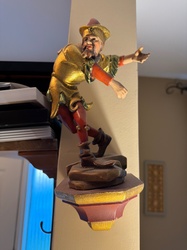
Submitted item photo
Submitted photo · May 16, 2026

User's notes

No additional notes provided.

AI analysis below

AI appraisal

AI analysis & estimate

AI-Generated · Verify before acting

Everything below is generated by AI for informational purposes only. AI can make mistakes — the AI may misidentify items or misattribute them (artist, maker, brand, designer, origin, era). This is not an official valuation and should not be used for insurance, sale, tax, estate, legal, or lending purposes — or any decision requiring a certified appraisal. It is not an authoritative claim about any person, brand, or rights holder — do not share or rely on it as a factual statement about a third party. Always consult qualified professionals before making financial decisions.

Read the full disclaimer

AI Identification

·Not independently authenticated·Verify before acting

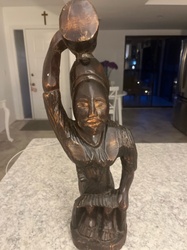
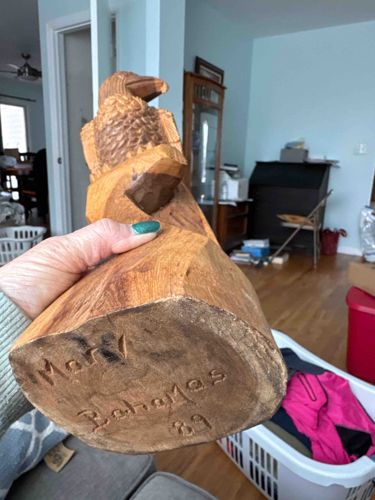
Vintage Hand-Carved Bahamian Wood Eagle Sculpture

Folk Art & Sculptures

AI Estimated Value

·Not an official valuation·Verify before acting

$125 - $225

As of May 16, 2026

AI Item Analysis

·AI can make mistakes·Verify before acting
This is a hand-carved folk art sculpture of an eagle perched on a branch, crafted from a single solid block of native Bahamian wood, likely mahogany or a similar dense tropical hardwood. The piece exhibits a medium-brown tone with a natural, visible grain pattern. The carving style is rustic and textured, featuring repetitive scalloped gouge marks to represent the eagle's plumage and deep, angular chiseling on the base and beak. The base is an integral part of the log, showcasing a large, flat-bottomed elliptical surface. On the underside, the piece bears hand-carved inscriptions including the name 'Mary', the location 'Bahamas', and the date '89', indicating it was created or purchased in 1989 as a souvenir or local handicraft. Physically, the item shows signs of minor shelf wear and age-related patina, with small scuffs and dust accumulation in the crevices of the textured carving. The craftsmanship is representative of late 20th-century Caribbean tourist art, emphasizing the raw material's natural beauty through bold, manual tool work. There are no signs of major structural damage, such as large cracks or split wood, though the surface finish appears matte and unpolished, consistent with the primitive style.
AI Appraisal Report

·AI can make mistakes·Verify before acting
I have virtually examined this hand-carved Bahamian wood eagle sculpture, dated 1989. The piece is a classic example of late-20th-century Caribbean folk art, likely carved from a dense tropical hardwood such as Mahogany or Lignum Vitae. The attribution to 'Mary' and the 'Bahamas' inscription provides excellent geographic and chronological markers, which enhance its appeal to collectors of regional handicrafts. From a visual standpoint, the condition appears Very Good. The 'scalloped' gouge technique demonstrates a confident, rustic hand, and the lack of visible checking or structural splits suggests the wood was properly cured for the local climate. Market conditions for 'tourist' folk art remain stable; while these pieces are not rare, the sheer scale and the use of a single-block carving method elevate this above smaller mass-produced souvenirs. Comparables for signed Caribbean hardwood carvings of this size typically hammer in the low hundreds at regional auctions. The valuation is driven by the density of the wood and the 'primitive' aesthetic. However, a significant limitation of this digital inspection is the inability to verify the weight and scent of the wood. A physical examination is required to confirm the species of wood and to ensure that the 'patina' is natural rather than a topical stain applied to hide sapwood or defects. Furthermore, provenance regarding the carver 'Mary'—specifically if she was a known local artisan versus a hobbyist—could potentially double the value. For full authentication, I would recommend checking for any hidden carver’s marks within the deep chiseling of the base and cross-referencing Bahamian craft guild records from the late 1980s.

Get your items appraised

Instant estimates of your treasures with AI-powered appraisals

Browse More Appraisals