AI estimate as of December 16, 2025 · verify with a professional before acting
AI-Generated · Verify before acting
Everything on this page is generated by AI for informational purposes only. AI can make mistakes — the AI may misidentify items or misattribute them (artist, maker, brand, designer, origin, era). This is not an official valuation and should not be used for insurance, sale, tax, estate, legal, or lending purposes — or any decision requiring a certified appraisal. It is not an authoritative claim about any person, brand, or rights holder — do not share or rely on it as a factual statement about a third party. Always consult qualified professionals before making financial decisions.
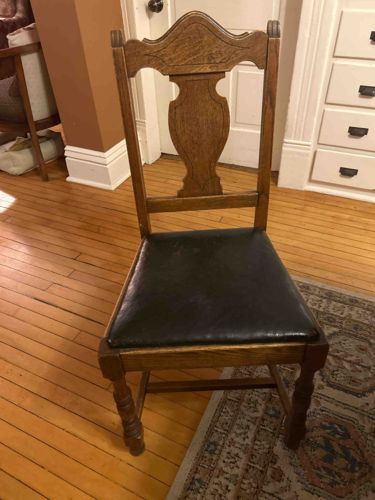
This is an antique dining chair, likely dating to the early to mid-20th century, crafted in the Jacobean Revival style. The chair is constructed primarily from oak, exhibiting a rich, medium-brown finish with a visible wood grain that suggests quarter-sawn oak, often indicative of quality during this period. Its backrest features a distinctive, ornately carved top rail with a scallop-like profile and a central, vase-shaped splat with carved detailing, characteristic of Jacobean design. The overall form is quite robust. The seat is upholstered in a dark, possibly black or very dark brown, faux leather or vinyl material, showing some scuffing and minor indentations consistent with regular use, but no major tears are immediately visible. The seat appears to be firmly padded. The front legs are turned with a spiral or barley twist motif, terminating in block feet, while the back legs are simpler and straight, a common practice for stability. Stretchers connect the legs for added structural integrity, though their exact configuration isn't fully clear from the image. The wood exhibits an age-appropriate patina, with some visible wear, nicks, and scratches on the edges and surfaces, particularly on the legs and seat frame, reflecting its age and usage. There are no obvious signs of significant repairs or major damage, though a closer inspection would be required to confirm. The craftsmanship appears solid and built to last, typical of furniture from this era. The style indicates it would have been part of a larger dining set.
AI Appraisal Report
Based on my visual examination of the provided image, this Antique Oak Jacobean Style Dining Chair appears to be a good example of early to mid-20th century Jacobean Revival furniture. The construction from what appears to be quarter-sawn oak, along with the distinctively carved backrest, spiral-turned front legs, and overall robust form, aligns well with characteristics of this style and period. The rich medium-brown finish and visible wood grain are attractive and suggest quality appropriate for the era.
The condition appears to be consistent with its age and intended use. I observe an age-appropriate patina, with minor wear, nicks, and scratches on the wood surfaces, particularly on the legs and seat frame. These are expected for a piece of this vintage and generally do not detract significantly from its value unless excessive. The upholstery, while showing scuffing and minor indentations, appears intact without major tears, suggesting it has been maintained or previously replaced. The solid craftsmanship noted is typical for furniture of the period, which was often built to last.
Market conditions for individual Jacobean Revival dining chairs can vary. While dining sets of this style once commanded higher prices, individual chairs are generally more accessible. Demand is moderate, often driven by collectors seeking to complete sets or individuals looking for accent pieces. This particular chair doesn't exhibit features that would suggest extreme rarity.
Factors impacting its value positively include the solid oak construction, the detailed carving, and its generally good, usable condition with no obvious major damage or repairs. The fact that it's a single chair rather than part of a complete, matching set does limit its top-end value. Were it part of a set, the collective value would likely be higher per piece.
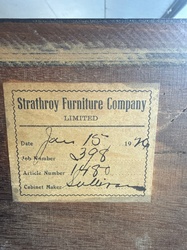
It is crucial to note the limitations of an appraisal based solely on images. Without a physical inspection, I cannot definitively verify the wood type (though it strongly appears to be oak), confirm the exact construction methods, assess the stability of all joints, or detect any internal repairs or hidden damage. An in-person examination would allow me to thoroughly inspect joints, confirm the type and condition of the upholstery material definitively, investigate the extent of wear and any potential structural weaknesses, and look for maker's marks or labels. Without provenance documentation, full authentication of origin or specific manufacturer is also limited.