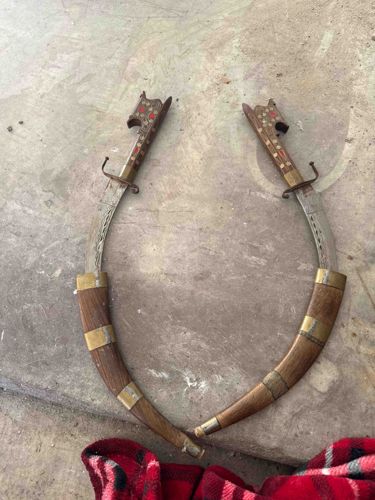
Pair of Moroccan Koummya Daggers
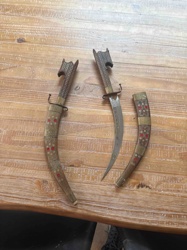
This is a matched pair of Moroccan Koummya daggers, which are the traditional curved daggers of the Berber and Maghreb regions. Each dagger features a characteristic curved, single-edged steel blade with decorative engravings along the upper spine and flat. The hilts are constructed from polished wood, possibly walnut or cedar, intricately inlaid with small circular and geometric patterns of brass and red pigment/composite material. The pommels exhibit the distinctive peacock-tail or fan-shaped silhouette typical of 20th-century craftsmanship. Each hilt is protected by a small brass crossguard with forward-sweeping quillons. The matching scabbards are fashioned from wood and reinforced with four brass bands used for both structural support and attachment. The condition shows significant age-related wear, including heavy oxidation and darkening (patina) on the brass elements, minor surface rust on the steel blades, and some scuffing to the wooden surfaces. These items likely date from the mid-to-late 20th century and were produced as high-quality tourist trade items or ceremonial attire pieces. The craftsmanship is folk-style, showing hand-tooling throughout the metalwork and inlay.
AI-Generated Appraisal Disclaimer
Estimated Value
$150 - $250
Basic Information
Category
Antique/Vintage Edged Weapons & Militaria
Appraised On
January 3, 2026
Estimated Value
$150 - $250
Item Description
This is a matched pair of Moroccan Koummya daggers, which are the traditional curved daggers of the Berber and Maghreb regions. Each dagger features a characteristic curved, single-edged steel blade with decorative engravings along the upper spine and flat. The hilts are constructed from polished wood, possibly walnut or cedar, intricately inlaid with small circular and geometric patterns of brass and red pigment/composite material. The pommels exhibit the distinctive peacock-tail or fan-shaped silhouette typical of 20th-century craftsmanship. Each hilt is protected by a small brass crossguard with forward-sweeping quillons. The matching scabbards are fashioned from wood and reinforced with four brass bands used for both structural support and attachment. The condition shows significant age-related wear, including heavy oxidation and darkening (patina) on the brass elements, minor surface rust on the steel blades, and some scuffing to the wooden surfaces. These items likely date from the mid-to-late 20th century and were produced as high-quality tourist trade items or ceremonial attire pieces. The craftsmanship is folk-style, showing hand-tooling throughout the metalwork and inlay.
Related Tags
Get Your Items Appraised
Instant estimates of your treasures with AI-powered instant appraisals