AI Appraisal Estimate

AI-generated estimates · not official valuations

From the user

What was submitted

Photo and notes provided by the user — not generated by AI

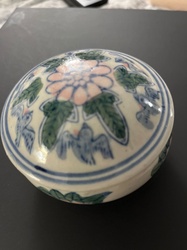
Submitted item photo
Submitted photo · June 15, 2026

User's notes

No additional notes provided.

AI analysis below

AI appraisal

AI analysis & estimate

AI-Generated · Verify before acting

Everything below is generated by AI for informational purposes only. AI can make mistakes — the AI may misidentify items or misattribute them (artist, maker, brand, designer, origin, era). This is not an official valuation and should not be used for insurance, sale, tax, estate, legal, or lending purposes — or any decision requiring a certified appraisal. It is not an authoritative claim about any person, brand, or rights holder — do not share or rely on it as a factual statement about a third party. Always consult qualified professionals before making financial decisions.

Read the full disclaimer

AI Identification

·Not independently authenticated·Verify before acting

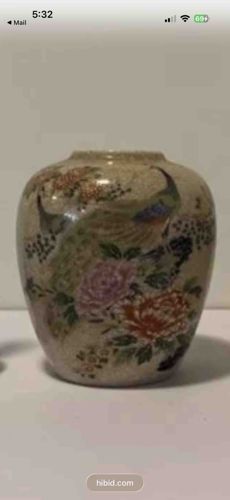
Japanese Satsuma-Style Ovoid Ceramic Ginger Jar with Peacock and Peony Motif

Antique Ceramics and Asian Art

AI Estimated Value

·Not an official valuation·Verify before acting

$45.00 - $75.00

As of June 15, 2026

AI Item Analysis

·AI can make mistakes·Verify before acting
This item is an ovoid-shaped ceramic ginger jar or vase, likely of Japanese origin and crafted in the celebrated Satsuma style. The vessel is constructed from earthenware with a characteristic cream-colored crackle glaze that serves as a canvas for the detailed polychrome enamel decorations. The central motif features a brightly colored peacock with its plumage trailing amidst large flowering peonies in shades of pink, orange, and mauve. The artistry employs gold-tone accents (moriage or gilding) to highlight the feather details and floral outlines, typical of late Meiji to Taisho period aesthetics or early 20th-century export ware for the Western market. The jar features a short, narrow neck without its original lid. The body tapers gracefully toward a flat, circular base. Physically, the piece shows a consistent all-over fine crackle pattern, which is an intentional design element of Satsuma pottery. However, some darkening of the crackle lines suggests age and handling. There are no visible chips or cracks from this angle, though the lack of a lid and potential fading of the gilding on the rim are noted condition factors. The craftsmanship exhibits typical mass-produced quality for the mid-20th century decorative market, though it maintains the elaborate visual appeal of traditional Satsuma wares.
AI Appraisal Report

·AI can make mistakes·Verify before acting
I have examined the digital representation of this Japanese Satsuma-style ovoid vessel. The item displays the cream-toned, crazed earthenware body characteristic of Satsuma-yaki, decorated in polychrome enamels with gilding. The motif—a peacock among peonies—is a classic theme intended for the export market. Based on the quality of the 'moriage' (raised enamel) and the somewhat standardized treatment of the floral elements, I identify this as a mid-20th century decorative export piece, likely from the Showa era, rather than a high-art Meiji period masterpiece. The condition appears fair, with the notable absence of the original lid, which significantly diminishes the value for serious collectors. There is visible 'tea-staining' or darkening within the crackle glaze, suggesting porousness or environmental exposure over several decades. The gilding on the rim shows signs of wear consistent with age and handling. Market demand for mid-tier, lidless Satsuma-style export ware is currently soft, as these items were mass-produced in large quantities for the Western giftware market. It lacks the intricate 'thousand faces' or 'miniaturist' detail of pieces by masters like Kinkozan or Yabu Meizan. Authenticity cannot be fully certified without an in-person inspection of the base for a red-oxide 'Shimazu' family crest or a specific studio mark. Furthermore, a physical examination is required to check for internal 'star' cracks or professional restoration that may be invisible in photographs. For a definitive valuation, I would recommend a black-light test to identify overpainting and a review of any existing provenance documentation to determine its specific import timeline.

Get your items appraised

Instant estimates of your treasures with AI-powered appraisals

Browse More Appraisals