AI Appraisal Estimate

AI-generated estimates · not official valuations

From the user

What was submitted

Photo and notes provided by the user — not generated by AI

Submitted item photo
Submitted photo · May 19, 2026

User's notes

No additional notes provided.

AI analysis below

AI appraisal

AI analysis & estimate

AI-Generated · Verify before acting

Everything below is generated by AI for informational purposes only. AI can make mistakes — the AI may misidentify items or misattribute them (artist, maker, brand, designer, origin, era). This is not an official valuation and should not be used for insurance, sale, tax, estate, legal, or lending purposes — or any decision requiring a certified appraisal. It is not an authoritative claim about any person, brand, or rights holder — do not share or rely on it as a factual statement about a third party. Always consult qualified professionals before making financial decisions.

Read the full disclaimer

AI Identification

·Not independently authenticated·Verify before acting

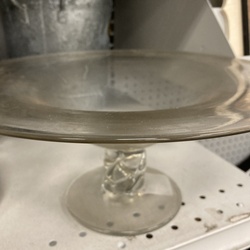
Pressed Glass Cake Stand with Star and Cross-Hatched Motif

Antique and Vintage Glassware

AI Estimated Value

·Not an official valuation·Verify before acting

$25.00 - $45.00

As of May 19, 2026

AI Item Analysis

·AI can make mistakes·Verify before acting
This item is a circular pedestaled cake stand or platter crafted from clear pressed glass. The design features a prominent geometric pattern composed of a large six-pointed star shape that encompasses the central plate. Inside the triangular points of the star, there are alternating patterns: some feature deep vertical sunburst or fan-like cuts, while others contain a fine cross-hatched or diamond-point grid. The rim of the plate is finished with a scalloped, saw-tooth edge, providing a textured tactile border. The central pedestal or 'foot' of the stand is visible through the clear glass, showing a matching starburst pattern on its base to maintain design continuity. Based on the sharpness of the pattern and the clarity of the material, this piece appears to be a mid-20th-century reproduction of earlier Early American Pattern Glass (EAPG), likely produced by a manufacturer like Anchor Hocking or Indiana Glass. The glass exhibits a bright, colorless quality with no significant yellowing or cloudiness typical of frequent dishwasher use. Condition-wise, the piece appears to be in very good vintage state; there are no visible chips or cracks along the delicate scalloped rim, and the surface shows minimal scratching from knife use. It lacks visible maker's marks, which is common for mass-produced utility glassware of this era. This style of 'Brilliant' cut glass mimicry was highly popular for domestic settings between 1940 and 1970.
AI Appraisal Report

·AI can make mistakes·Verify before acting
Based on my visual examination of this pressed glass cake stand, I have identified it as a mid-20th-century piece, likely produced between 1940 and 1970. The design mimics the 'Brilliant Period' cut glass style through more affordable pressing techniques. The pattern, featuring six-pointed stars and diamond-point cross-hatching, is consistent with mass-produced patterns from manufacturers such as Indiana Glass or Anchor Hocking. The glass exhibits high clarity with no signs of the 'sick glass' clouding often seen in poorly maintained vintage pieces. The saw-tooth rim appears intact, which is critical as these edges are highly susceptible to chipping. The current market for mid-century pressed glass is stable but saturated. While highly functional and aesthetically pleasing for domestic use, these items were mass-produced, making them common rather than rare. Comparable sales on secondary markets for similar unbranded pedestaled stands range consistently between $20 and $50 depending on regional demand and retail venue. The lack of a maker's mark is standard for utility glassware of this era and does not negatively impact value. Limitations of this appraisal include the inability to perform a 'ring test' to determine lead content or check for microscopic base wear that confirms age. To fully authenticate this piece and rule out modern late-20th-century reproductions, an in-person inspection under UV light is required; EAPG and early mid-century glass often contain manganese or selenium which fluoresce under blacklight. Provenance documentation regarding its original purchase or family history would further solidify its attribution.

Get your items appraised

Instant estimates of your treasures with AI-powered appraisals

Browse More Appraisals