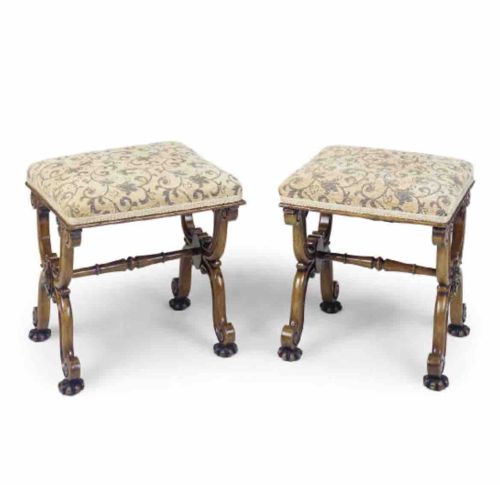
A NEAR PAIR OF VICTORIAN WALNUT STOOLS MID-19TH CENTURY Each with a padded seat on moulded X-frame legs and reeded pad feet, variation in the size of the seats The seats: 16in. (41cm.) square; 16½in. (42cm.) wide; 17¼in. (43.5cm.) deep (2). PURCHASED AT CHRISTIE’S INTERIORS - STYLE & SPIRIT, LIVE AUCTION 5347, LOT 245, in London (South Kensington) on February 26, 2008.
These notes were written by the person who submitted this item. Appraiser.AI has not verified them, and the AI's identification and estimate may rely on them.
AI Estimated Value
Not an official valuation
$1,000-1,500
AI estimate as of September 30, 2025 · verify with a professional before acting
AI-Generated · Verify before acting
Everything on this page is generated by AI for informational purposes only. AI can make mistakes — the AI may misidentify items or misattribute them (artist, maker, brand, designer, origin, era). This is not an official valuation and should not be used for insurance, sale, tax, estate, legal, or lending purposes — or any decision requiring a certified appraisal. It is not an authoritative claim about any person, brand, or rights holder — do not share or rely on it as a factual statement about a third party. Always consult qualified professionals before making financial decisions.
This analysis also relies on unverified notes provided by the user, which may be incomplete or inaccurate and could affect the result.
This is a near pair of Victorian walnut footstools, estimated to date from the mid-19th century. Each stool features a padded, upholstered seat atop a finely crafted wooden base. The upholstery on both stools displays a consistent light-colored (possibly beige or cream) fabric with an intricate, repeating floral or foliate pattern in muted tones, likely blues, greens, or grays. A decorative trim, possibly gimp or cording, borders the lower edge of the upholstered seat. The wooden frame is constructed from walnut, exhibiting a rich, warm brown finish with a visible grain, suggesting a high-quality timber. The most distinctive feature of the construction is the elegantly carved X-frame legs. These legs are elaborately molded and carved with classical or rococo-inspired motifs, including scrolls and stylized leafwork visible on the cross-members and the upper sections of the legs. A central reeded stretcher, comprising multiple parallel grooves, connects the X-frame at its base, adding stability and decorative appeal. The feet are carved in a pad foot style, further distinguished by reeding or fluting, and possibly resemble paw feet, showing intricate detail. The stools appear to be in good overall condition, exhibiting a natural patina consistent with their age. No significant damage such as large cracks, breaks, or repairs are immediately apparent from the image, though close inspection would be required for a definitive assessment. The difference in size (one seat being 16 inches square, the other 16.5 inches wide and 17.25 inches deep) confirms they are a 'near pair,' indicating they were likely made around the same time or intended to be used together, but not as an exact match. The craftsmanship evident in the carving and joinery suggests a high level of skill. These pieces were part of Christie’s 'Interiors - Style & Spirit' live auction in London in 2008.
AI Appraisal Report
Based on my visual examination of the provided image and the supplied details, this near pair of Victorian walnut footstools appears to be in good overall condition, consistent with pieces from the mid-19th century. The natural patina observed on the walnut is indicative of age, and I see no overt signs of significant damage like large cracks or major repairs. The upholstery, while appearing well-maintained, would need in-person inspection to assess wear, tears, or potential fading not evident in the image. The elaborate X-frame design with its rococo-inspired carvings and reeded details is a hallmark of quality Victorian craftsmanship. The use of walnut, a desirable timber, further enhances their appeal.
From images alone, definitive authentication of age and materials is always limited. A physical inspection would allow me to determine the structural integrity of the joinery, verify the wood species definitively, and assess the original finish versus any later interventions. Without handling the pieces, I cannot confirm the exact composition of the upholstery fabric or the trim. Provenance, such as their purchase at Christie's, significantly adds to their authenticity and marketability, indicating they have passed through a reputable auction house. While 'near pair' status means they are not identical, their consistent style and complementary sizes maintain their collective value. The market for quality Victorian furniture, especially pieces with intricate carving and good provenance, shows steady demand from collectors and decorators seeking period charm and robust construction. The rarity is moderate; similar quality Victorian stools appear periodically.
Considering their age, craftsmanship, condition as presented, and reputable provenance, I would place their retail replacement value in the range of $1,000-1,500. This range accounts for their desirable aesthetic, the quality of materials and construction, and their auction history, while also acknowledging the limitations of a remote appraisal.